I do not remember exactly when this concept entered into my life, but when it did, it has always stayed there and have never thought about making it myself. Many people in the industry refer to this as an old school method of cooking as it was mainly famous in the 1970’s and 1980’s.
History
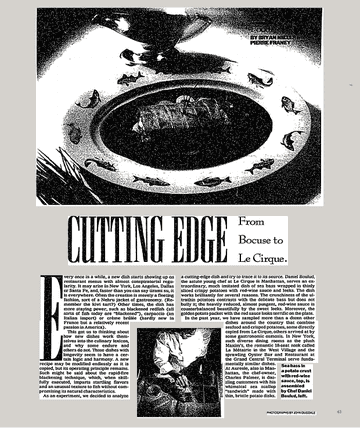
This dish
was at its peak in the 1980’s. The idea originally came to Paul Bocuse after he
had visited a food show in France a few decades ago. There he noticed cold
salmon dressed with slices of cucumber that were made to look like the scales
of a fish. After this experience he decided to try something alike using
potatoes instead of cucumbers and made it a hot dish instead of cold. Fish with
potato scales had been popular at Bocuse’s restaurant for a very long time.
Daniel Boulud,
chef at the time at Le Cirque, New York, says that he got the inspiration for
this dish from Paul Bocuse. Boulud trained under Bocuse for about four days and
was fortunate enough to stumble upon this technique that he fell in love with. He
tried various cuts of potatoes along with various other types of fish. In his
restaurant thirty to forty portions of this particular dish was sold on a daily
basis.
This concept of a crispy element in a dish can be used for various other seafood as well. Back in the day at Aureole, New York, chef Charles Palmer was very well known for his creation of sea scallop sandwich which included very thin and fragile potato disks. A twist of this dish was famous at Citrus in Los Angeles, where chef Michel Richard used to prepare bay scallops folded inside golden crust of shredded potatoes. Similarly, there were many different twists picked up from this concept and it was very popular during this time of the century.
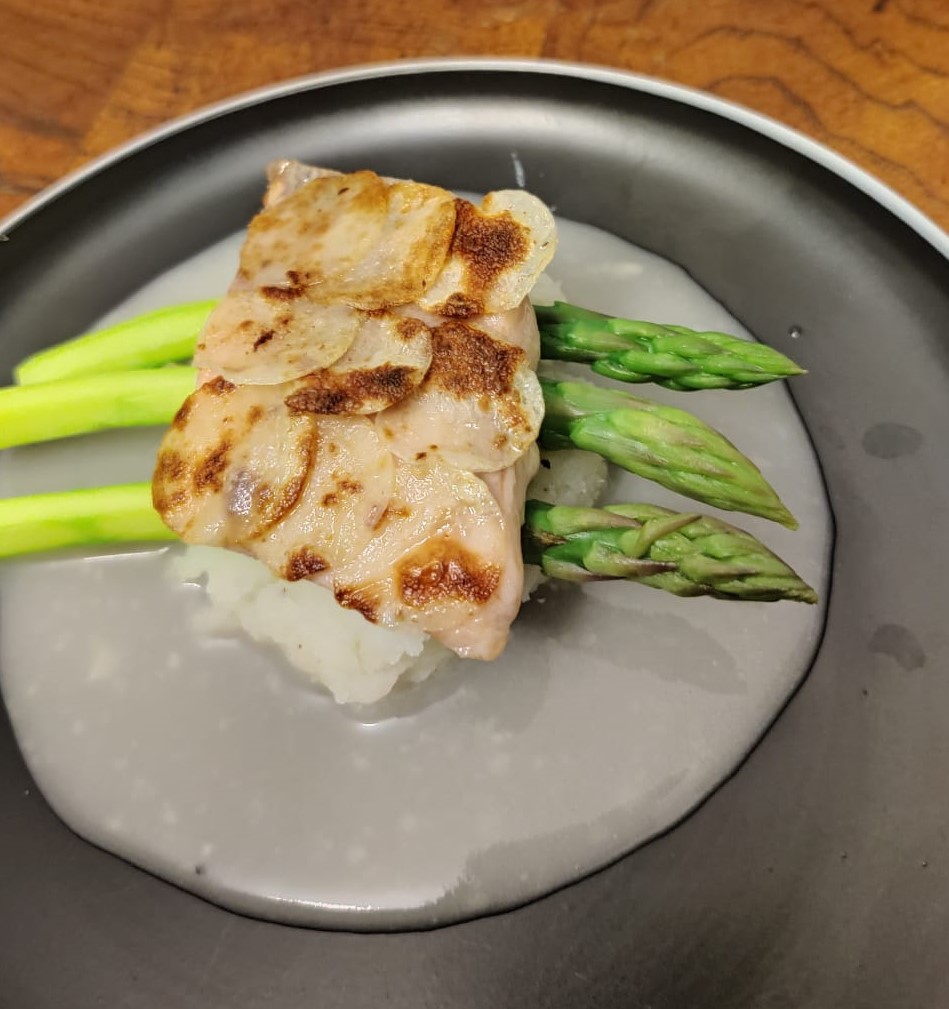
I took a try making this dish. For this I purchased a whole rainbow trout and decided to process it myself. It was much more difficult to make than I originally thought it would be. The potato crisps would not stick to the fish at all and later realized that I had to dip the potato disks in some sort of fat. I completed the dish by pan searing the trout and frying the disks separately just so I would be familiar about how it would taste. For this sauce I needed some tart ingredient and decided to use the pickling liquid from my carrot pickle. I made a fish stock from the carcass of the fish and added fennel bulb, onion and carrot. I made a roux and added this fish stock in this and also added the pickling liquid in this (This was probably one of the best sauces I have prepared to pair with seafood) (Click here for the pickle recipe: https://theoryof.food.blog/2019/07/29/pickled-carrots/ ). In the plate I poured the sauce, placed some mashed potato in the middle, blanched asparagus over it and then finally, the potato scaled fish.
This leads me to the point that why this is important in the industry as well as why it is important for me. Whenever dishes like this make an entrance in the culinary world there is a spark of inspiration spread among everyone in the industry, including chefs and culinary students. Innovations make us realize that there are infinite possibilities when it comes to the techniques of how to cook food.
As students aspiring to work in this professional industry of food and nutrition, it is imperative to understand certain diets that people follow. People choose certain diets based on what lifestyle they want to lead or they physically cannot consume some ingredients, i.e. allergies. The best way to understand these lifestyle choices and allergies is to actually follow.
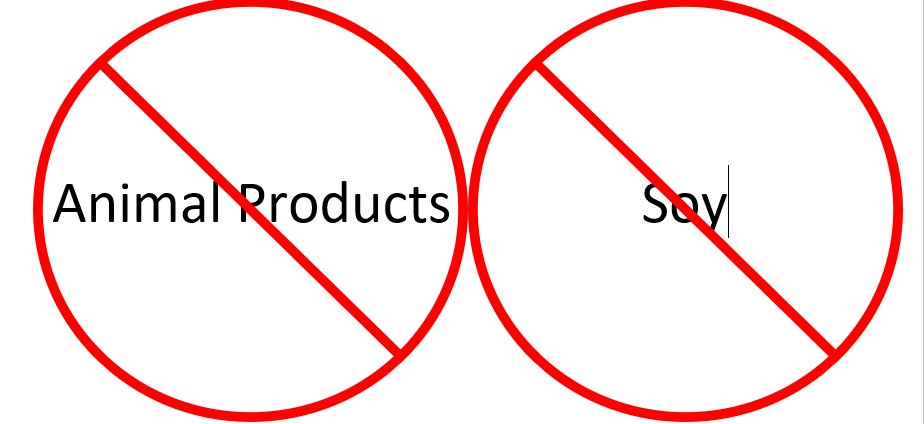
For my assignment the diet that I have picked is the Vegan diet. And one dietary restriction that I have picked is soy based products. This I have done because of a simple reason, I always rely on animal products and various soy based sauces for my daily nourishment. I wanted to experience how hard it actually might be for me to live by a diet that restricts the very things that I rely upon.
Daily Menu
My blog does not contain a log in a proper table format, but this is the general idea of how my everyday diet looked like because it was very similar everyday.
Breakfast
Student life is not easy, and there is not much time in the morning after you wake up and have to leave for college. The breakfast that I usually made was half a roasted tomato topped with a fresh basil leaf, and roasted baby potatoes. I know what you must be thinking, “This is not really a quick breakfast”. Instead of using the oven, I would roast them in a pan. It wouldn’t take more than fifteen minutes along with the mise en place of chopping the vegetables and tossing the potatoes in olive oil and dry herbs. I would have this breakfast with a nice cup of black coffee. There were days that I would have to rush, and so I would resort to plain dry corn flakes.
Lunch
My lunch was more or less the same thing everyday. I would toss rice in a pan with some other vegetables. I would try different vegetables everyday, sometimes adding a few spices and making ‘Masala Rice’. Basically I would make fried rice without the Soy sauce and some protein such as chicken, which was a big challenge to come over. Although, vegan option was just as delicious. I would lightly fry ginger, garlic and chilly and then add sliced onions and caramelize them. Then I would pick my vegetables and/or spices and then proceed with the rice after sauteing well. It was very delicious and very filling.
Dinner
For my dinner, I preferred eating something that I already have started eating for a while now. Salads. There are so many different ways you can make a salad and so many different ingredients and dressings that you can use. My salads always have two constant ingredients which are romaine lettuce and kale. Kale is something I have started to quite enjoy eating on a daily basis.
Experience
To say that this challenge would be an extreme understatement as I am the sort of person that always rely’s on some sort of meat in some of my meals. One thing I can say is that the salad diet for dinner that I have been following for a while is a really good choice. It makes you feel very active and it becomes very easy to wake up in the mornings as you do not feel lazy (Maybe this just might be my experience). Overall, this diet did make me feel very active all the time and I do believe that it made me healthy as well. Now that the week was over, I do not think I will continue this diet. Although, I would like to refrain from animal products as much as possible, and once in a while, maybe do this challenge for a week.
Recipe – Aloo Sandwich
Aloo basically means potato in India (Hindi). This sandwich is completely vegan and is very filling with different vegetables inside.
Ingredients
Bread (make sure no dairy product is used to produce this)- 2 slices
Yellow flesh potato – 1 medium sized
Tomato- 1 tbsp finely chopped
Capsicum- 1 tbsp finely chopped
Carrot- 1 tbsp finely chopped
Red chilly powder- As per how spicy you want it
Turmeric- 1/4 tsp
Salt – to taste
Method
Chop the potato in medium sized cubes and boil them until tender in well seasoned water. Drain the water and keep the pot covered to let it steam inside.
Add turmeric, red chilly powder and salt and mash this mixture very well.
Add the capsicum, carrot and tomato inside this and mix it well.
Taste this mixture and adjust seasoning and spices as per required.
Toast the bread in a toaster or the oven.
Once the bread is toasted, spread the mash over the bread slice and make the sandwich. Make sure you get a thick spread throughout.
For this blog post, I got a really good opportunity perform something unconventional (in regard to college assignments). I had to visit a farmers market and got to talk to the farmers that were selling their products. Before the assignment brief, I learnt that there are so many farmers market across the city of Toronto, which I did not even know about before. There are farmers markets throughout the week except for Friday.
St. Lawrence Farmers Market
St. Lawrence farmers market
This was a random visit as I was just passing by the area. It was not my idea to go inside with the intention of keeping the assignment in mind. This farmers market is located just behind the St. Lawrence market and is operational every Saturday. The first thing to notice during this season are the variety of pumpkins and squashes that are sold on the entrance of the premises.
I did not spend much time inside of this place as I was getting late for something else, but I did get to chat with a lady at the counter of Chocosoltraders. They have a variety of products, all related to chocolate. They import cocoa beans from many different countries in South America. Along with their own range of chocolate products, they are also known to sell their cocoa beans to different places. One thing I learnt was that they are also known to sell their product to Soma Chocolatemaker (King st, west), which happens to be my favorite gelato place in the city.
Leslieville Farmers Market
The two famers in the center
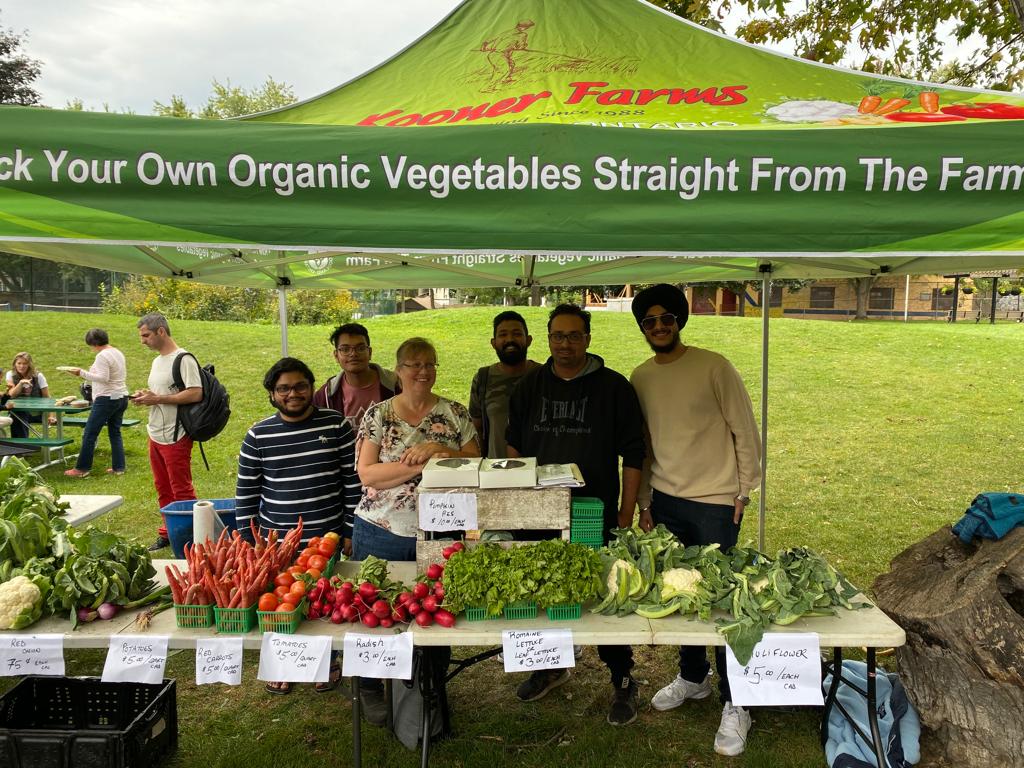
Leslieville is a very big market and has different farmers that come from across the city. there is a wide variety of produce that is available here. This market is operational on Sunday’s. I had gone to this place with a group of colleagues from college, and we got to talk to an enthusiastic farmer at the stall of Kooner Farms.
She has been working with Kooner farms for several years now. She chose farming as a career, because she wanted to be involved in growing food in a way that is beneficial to people as well as the planet. Kooner farms has been growing organic food since 1988. The sole philosophy of Kooner farms is growing organic food. This is done keeping in mind the sustainability aspect of growing produce. This is an increasingly important term that we are hearing everywhere these days because there has been a rapid decrease of resources around the world.
According to her, politics does not effect their business at large. But definitely, growing food in a country like Canada, there are several environmental factors. Firstly there is rain that is very unpredictable, and organic food is fragile, it can destroy crops at a large scale. During the winters there is hardly anything that can be grown, but even then there is a constant fear of a frost destroying the vegetables. During the winters, most of the farming is conducted in greenhouses. This does affect the business and the labor involved in growing things. Also the sea level rise is a constant fear. Although, she says that there still is a very long time before something like that happens.
When we visited, there were a variety of products on sale. There were lots and lots of cauliflowers, and other vegetables like tomatoes, romaine lettuce, carrots, red radishes.
Coming to the price comparison, it is slightly expensive to buy products from an organic shop such as this. For example, one cauliflower is worth five dollars. Which is probably three to four dollars more than what you pay at a Store like Freshco. But, compared to the price of what we have to pay in the future, with the drastic environmental changes happening, I do not really think that five dollars is that expensive.
What I Learnt
One thing that I learnt for sure, that there are more people in this world that care for this planet than I initially thought there were. Apart from that, I learnt that farmers market is the best and easiest way of getting any seasonal products that you want to buy. Buying from places like these should be made aware to the people that do not have a slightest clue of what their food actually contains.
For this particular assignment I had many different ideas of what to cook and at a point it got so confusing that I had no idea what to make. So I just decided to walk around St. Lawrence to look for some sort of inspiration. And there it was, right in from of me, something I always wanted to cook, but never had a proper access to back in my home country of India. A beautiful piece of beef tenderloin. Something that I also learned that day was that this was an expensive piece of meat. I ended up spending $28 for a kilo of it. Easily one of the most expensive meals that I would cook. This means that I have one chance to have a go at it and not mess it up. (Spoiler alert, I didn’t mess it up)
Beef
Courtesy of nationalpost.com
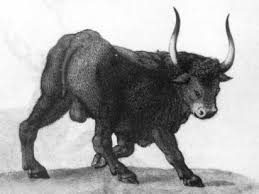
Beef is
basically meat that is obtained from a cow. The cattle of today are a progeny of
the wild European Aurochs. Compared to the cows of today, they were about 1.5
times bigger and weighed close to a ton. Humans began its domestication about
8000 years ago. Most of the beef and dairy bearing cows are related to the European
breed (Princess royal station 2015).
Some of the largest producers of beef on a global level are Australia, the USA, Canada, Argentina and Uruguay. India is one of the countries that produces a large quantity of the meat, but it ranks among the lowest when it comes to the consumption of it (Bali 2015).
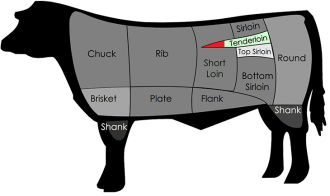
The Tenderloin
Courtesy of topratedstakehouses.com
Beef tenderloin is the tender-most part of all the other cuts. The tenderloin is a little oblong in its shape and spans both into the short loin and sirloin section of the cow. interestingly the T-bone and porterhouse are cut out from the short loin section of the cow. We know that the tenderloin extends into the short loin section. This contributes to a piece of tenderloin in both T-bone and porterhouse steaks. The T-bone actually separates the tenderloin and a New York strip (Subia 2019).
The tenderloin can be further cut down into four more cuts. The head, chateaubriand, tournedos and filet mignon (Bali 2015). This meat contains a bit of fat marbling between the meat, although not as much as other cuts. This makes it very popular among the crowd that likes to consume steak but are watching their fat intake levels. The steak made from this cut contains even less fat than the equal weight of chicken thighs (Subia 2019).
Cooking methods
Before we get into the perfect way of cooking a beef tenderloin, we need to understand a few things not to do with the precious cut. It is very crucial that you do not overcook the meat in any way. This cut is very lean and has very little fat in it. this means that if you cook it perfectly, it is the most tenderest cut to chew on. But if you overcook it, it becomes dry and tough in its texture. Another mistake that you might do is not season the meat enough. The tenderloin does not have a lot of fat to depend on for its flavor. This makes seasoning the meat very crucial (Gallary 2014).
The best way you could cook a tenderloin is by dry heat method such as baking, roasting, grilling the steak, etc. After cooking in this process, make sure that you let the meat rest for at least 10 to 15 minutes for the meat to reabsorb all of its juices. Other methods such as stewing is also acceptable, but the meat does not extract a lot of flavor in the stew and there is a high possibility of overcooking it.
Beef Wellington
The method that I have selected for my recipe is the dry heat method and the dish is beef wellington. I can safely say that this is a dish that has been on my mind for a very long time. The first time I learnt about this dish was from season 2, episode 2 of Master Chef Australia back in 2010. Most of the recipe that is followed here is inspired from Gordon Ramsay. (Video of the full recipe: https://www.youtube.com/watch?v=Cyskqnp1j64&t=192s )
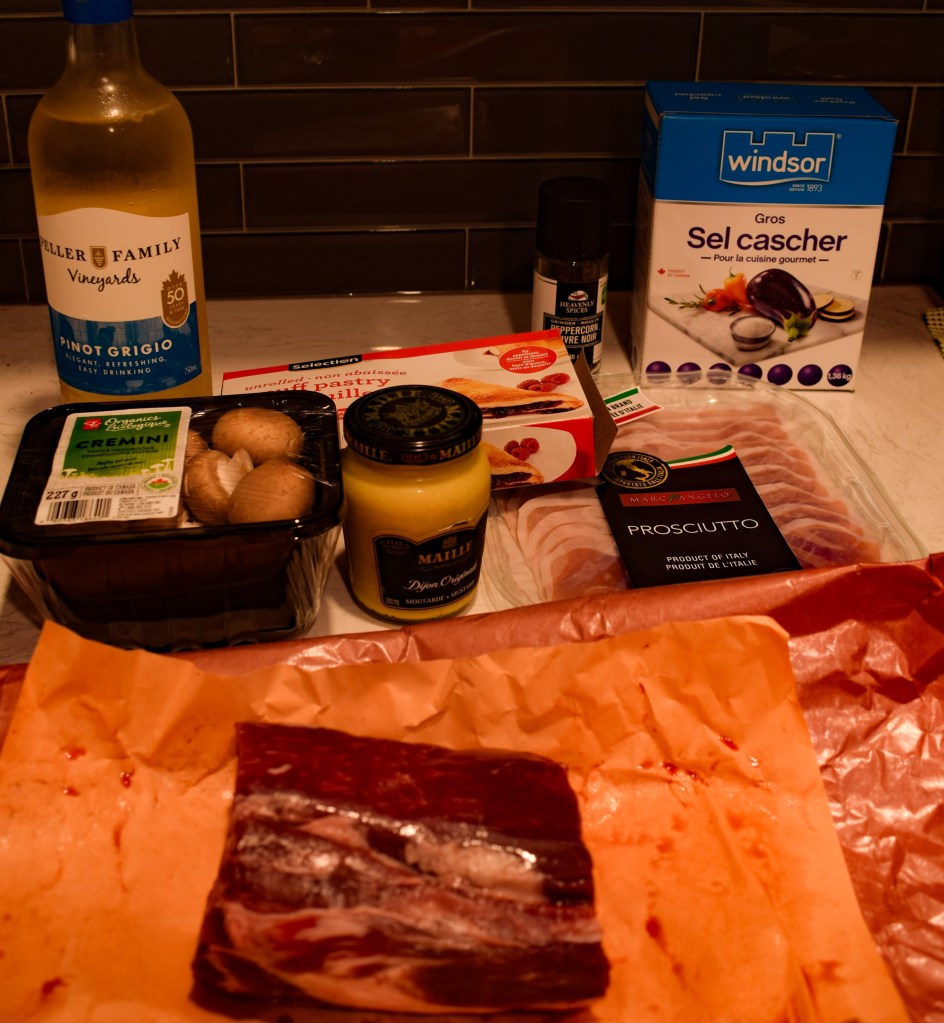
For this recipe you will require:
Most of the ingredients that you will need
Lets look at this one layer at a time:
At the centre
Olive oil 1 tbsp
Beef tenderloin 1 kg
Salt and pepper
Dijon mustard 2 tbsp
First layer (Mushroom duxelle)
Cremini mushrooms 500 g (other types or mixture of different mushrooms will also work)
Dry white wine 1/4 cup
Fresh rosemary
Second layer
Prosciutto 8 slices
Final layer
Puff pastry, as per required
Kosher salt
Yolk of one egg
Method
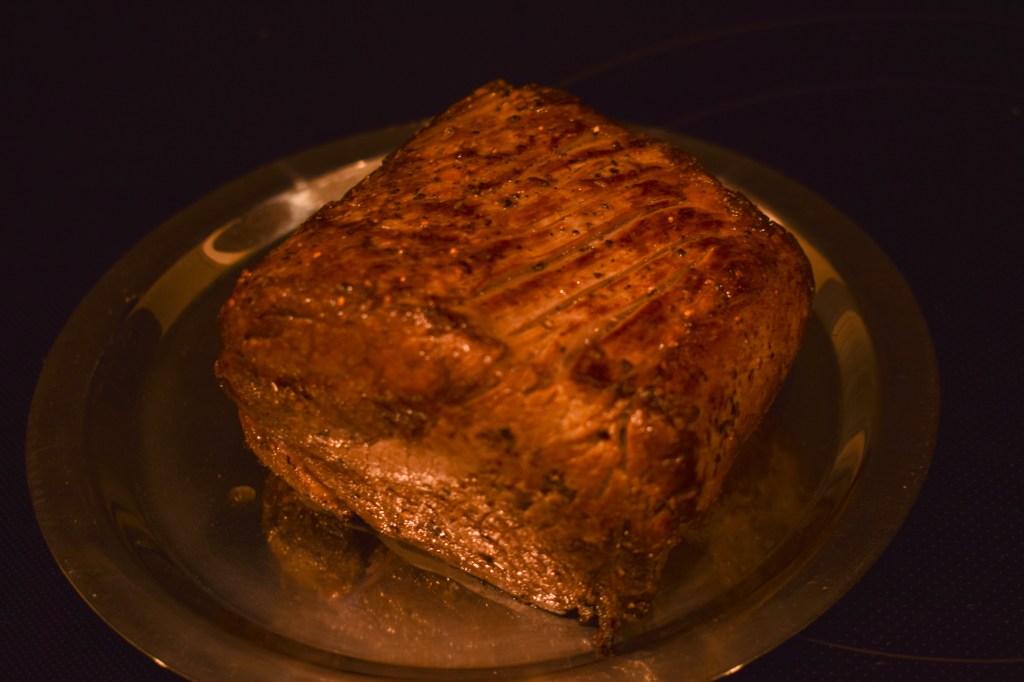
Season the tenderloin generously with salt and ground black pepper. Add olive oil in a hot pan and place the meat in it. You should hear a sizzle. We just want to sear the steak and give it a nice brown color on its exterior. Use tongs for this process
Seared tenderloin
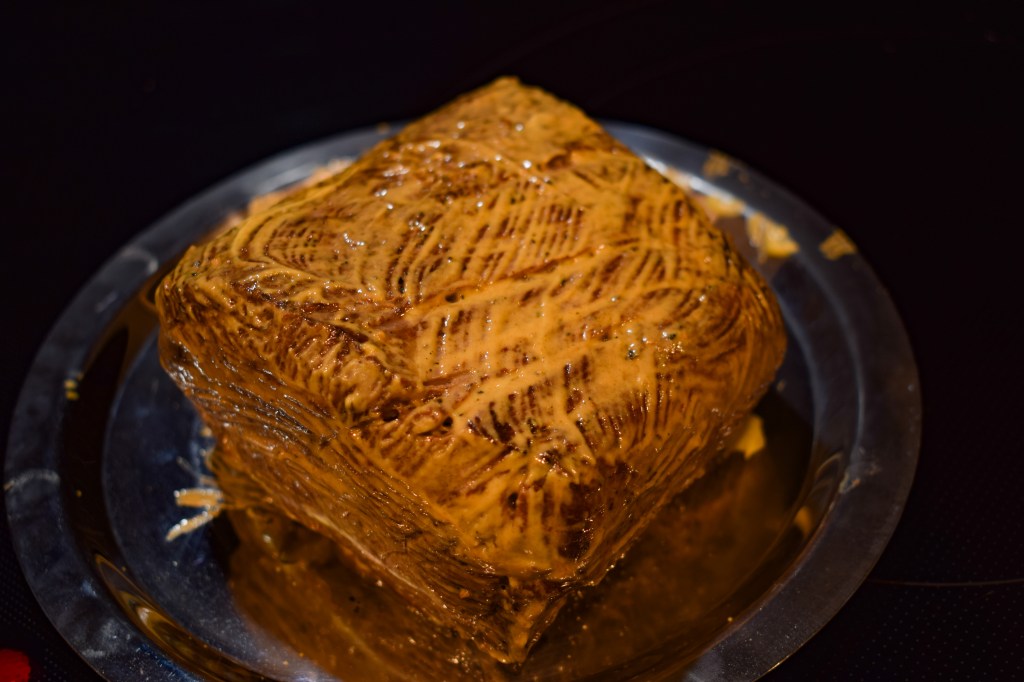
2. Once that is done, transfer this meat to a plate and brush it completely with Dijon mustard. Keep it aside to rest.
Tenderloin coated in dijon
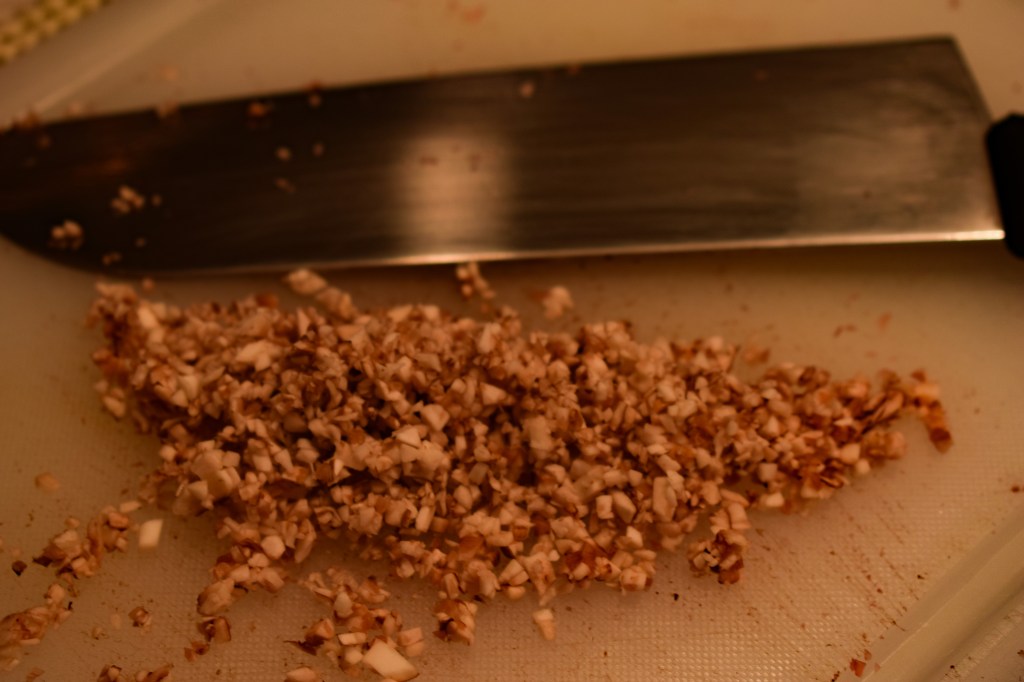
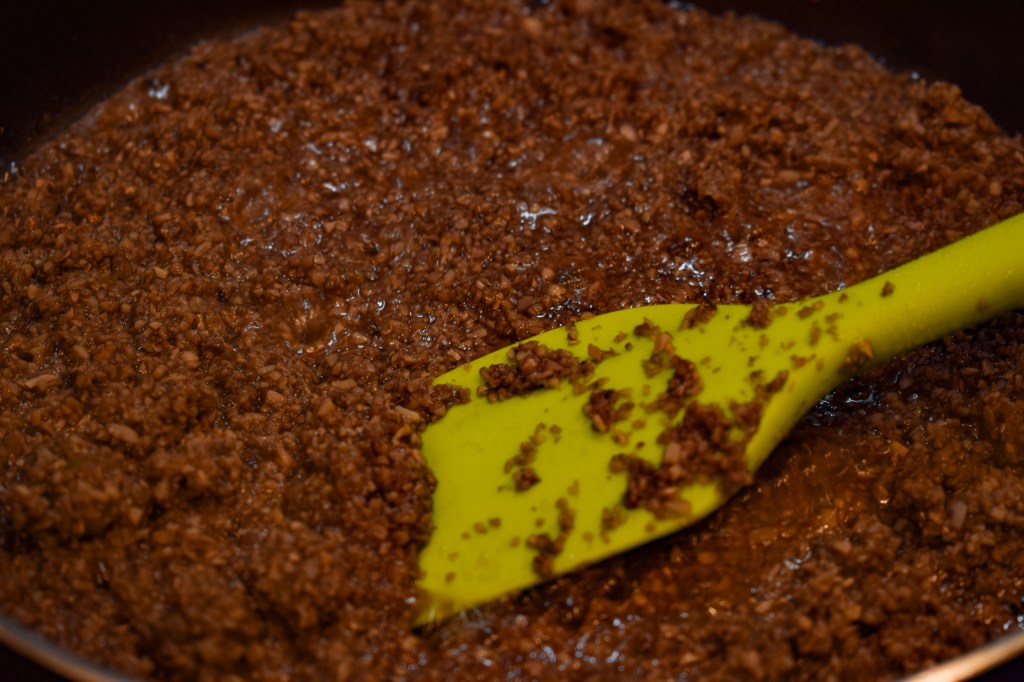
3. In a food processor, blend the mushrooms till they are very finely chopped. If you do not have a food processor this can be done on the chopping board and knife (took me an hour). Place this mushroom in a hot pan, without any oil, season it and start to toss it around the pan. As the moisture is starting to ooze out, add some rosemary and white wine in it. Cook this mixture till all the moisture has evaporated and you are left with a thick paste. Set aside to cool.
Minced mushroomMushroom duxelle before loosing all of its moisture
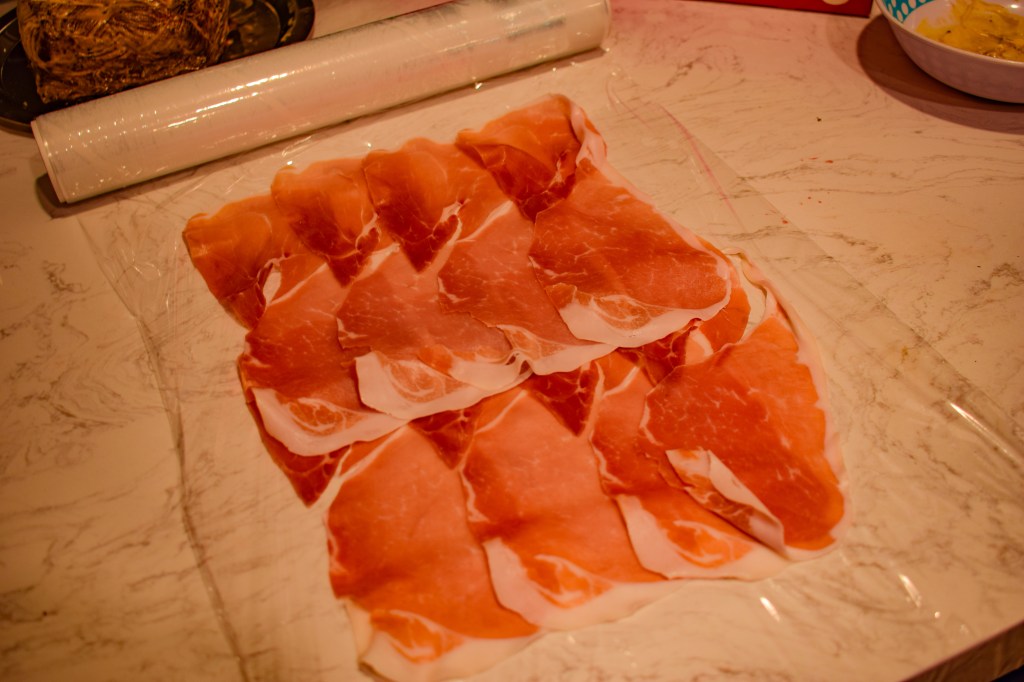
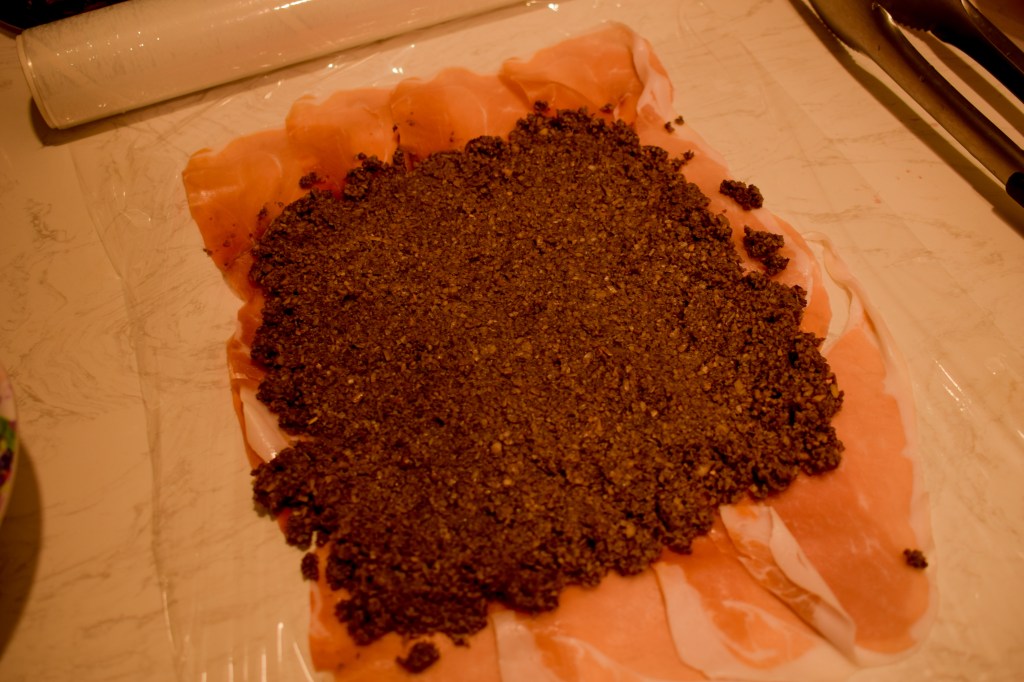
4. Spread cling wrap on your chopping board or your table, layer the Prosciutto on it in a neat manner. On this spread the mushroom duxelle, use the back of your spoon to make it very even.
Layered Prosciutto Mushroom dusxelle layered over Prosciutto
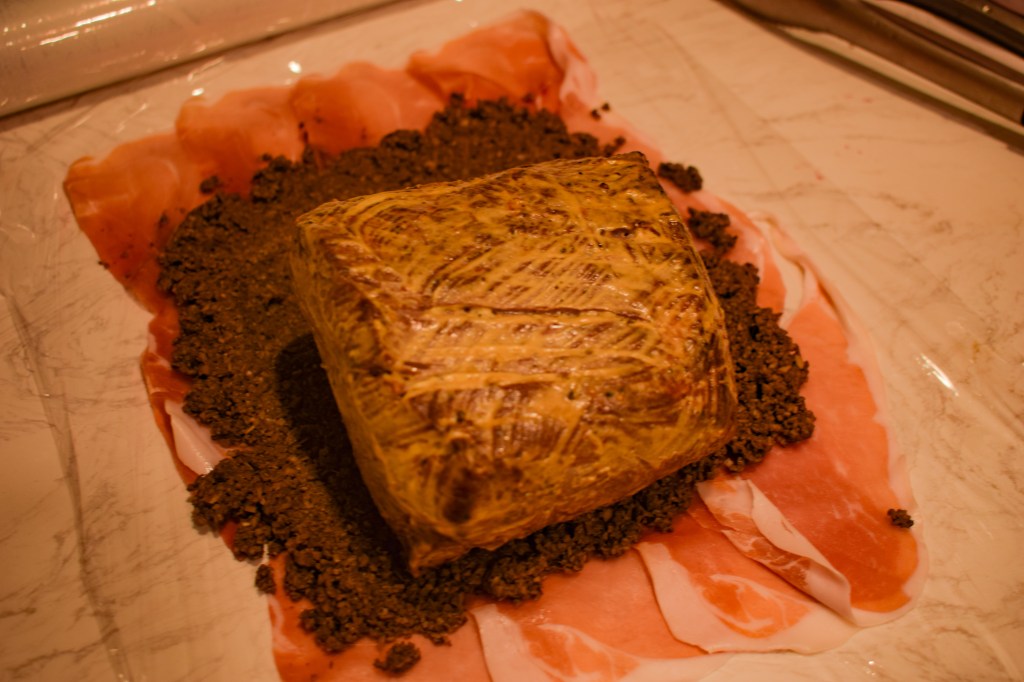
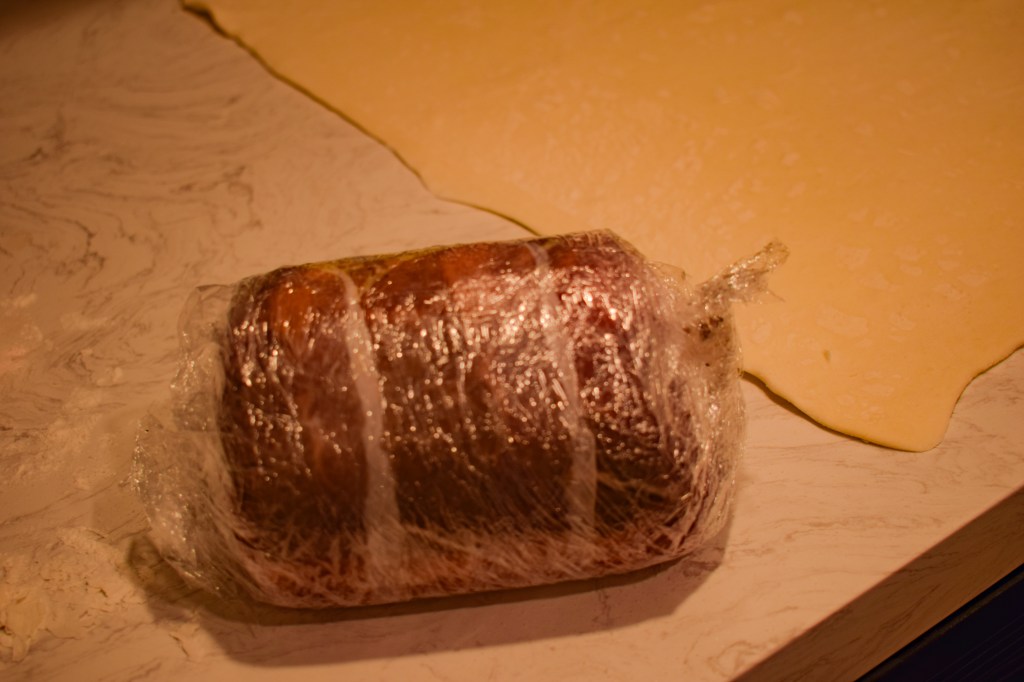
5. Place the meat onto the mushroom duxelle, with the help of the cling film, wrap the beef completely. At the edges, with the help of the cling film, twist it and make the roll very tight.
Meat ready to be wrapedTwisted and tied in cling film
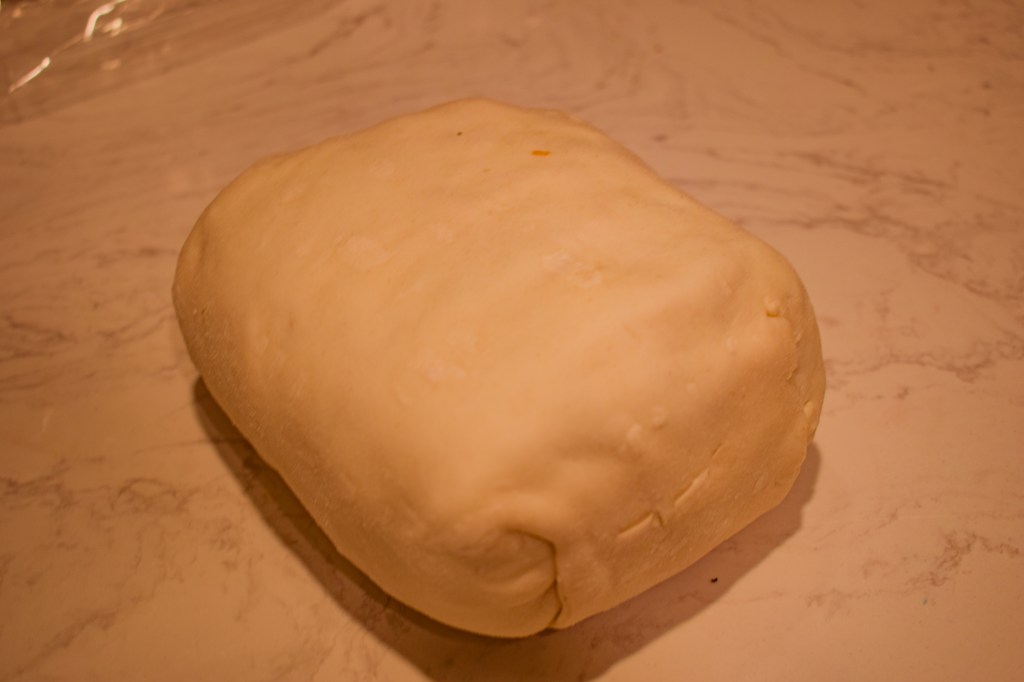
6. Refrigerate this for 15 minutes for it to set. Again set your table with the cling film and place puff pastry sheet on it. (If you are buying frozen puff pastry from the store, let it thaw in the fridge till it is soft. After this, roll it till it is at least 2 mm thick. Dust it with flour while rolling) Place the beef wrapped with the Prosciutto and mushroom onto the puff pastry. Give an egg wash (1 egg yolk and 1 tbsp of water) at the edges for the puff pastry to seal properly. Like before, with the help of cling film, twist at the edges and make a nice even roll. Place in the fridge for 5 more minutes for further setting.
Wrapped in puff pastry
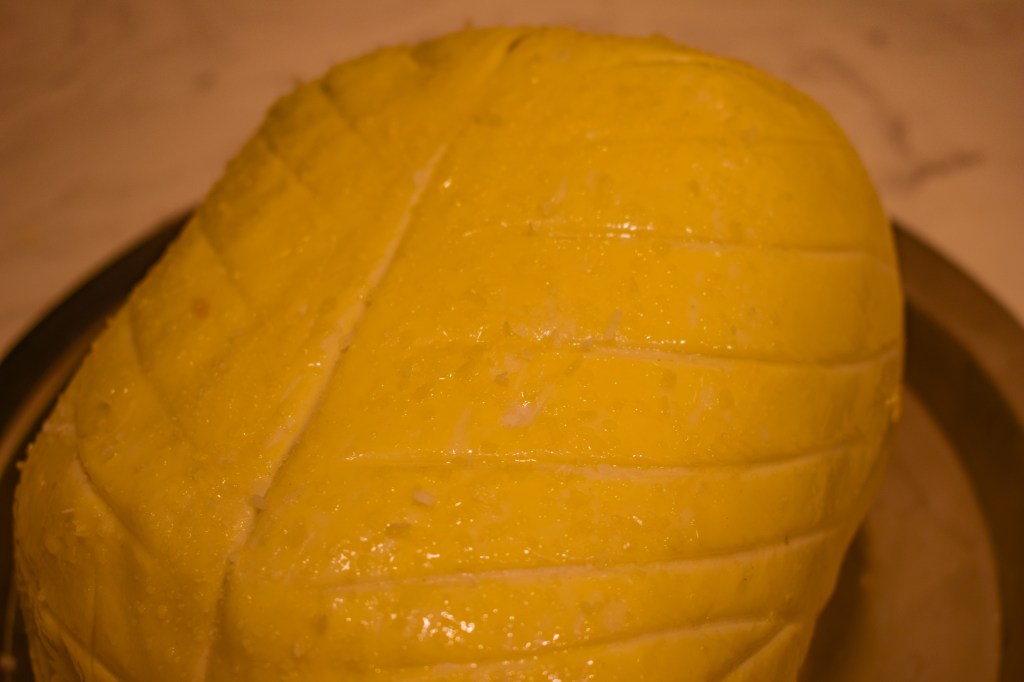
7. Oven should be pre-heated to 200°C (392°F). Give an egg wash to the roll and then gently score it to give it a simple design. Sprinkle with kosher salt to ensure crispiness. Bake for 35 minutes or a little longer if you do not like it rare.
Puff a pastry scored, egg washed, and seasoned
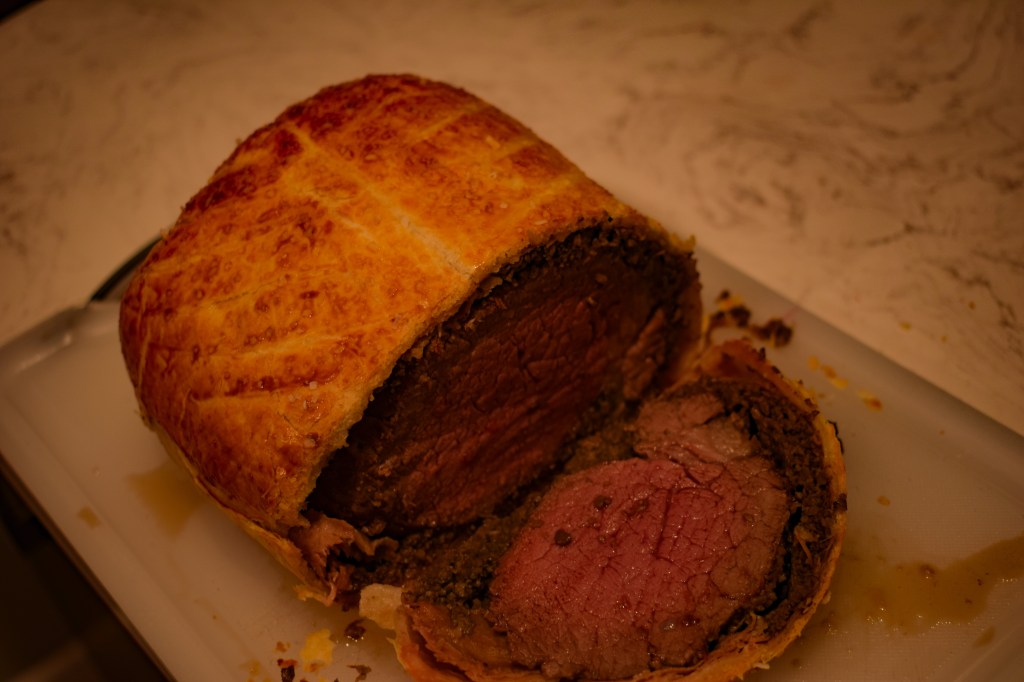
8. After baked, place the wellington on a chopping board. It is very important to let it rest for at least 10 minutes. This will allow all the moisture to be reabsorbed in the meat. Use a bread knife for slicing, and make sure that you get thick slices (at least 2 inches). If you make it too thin, the meat will dry out quick. You can make a jus in the pan that was used to sear the tenderloin. It will go well with the dish.
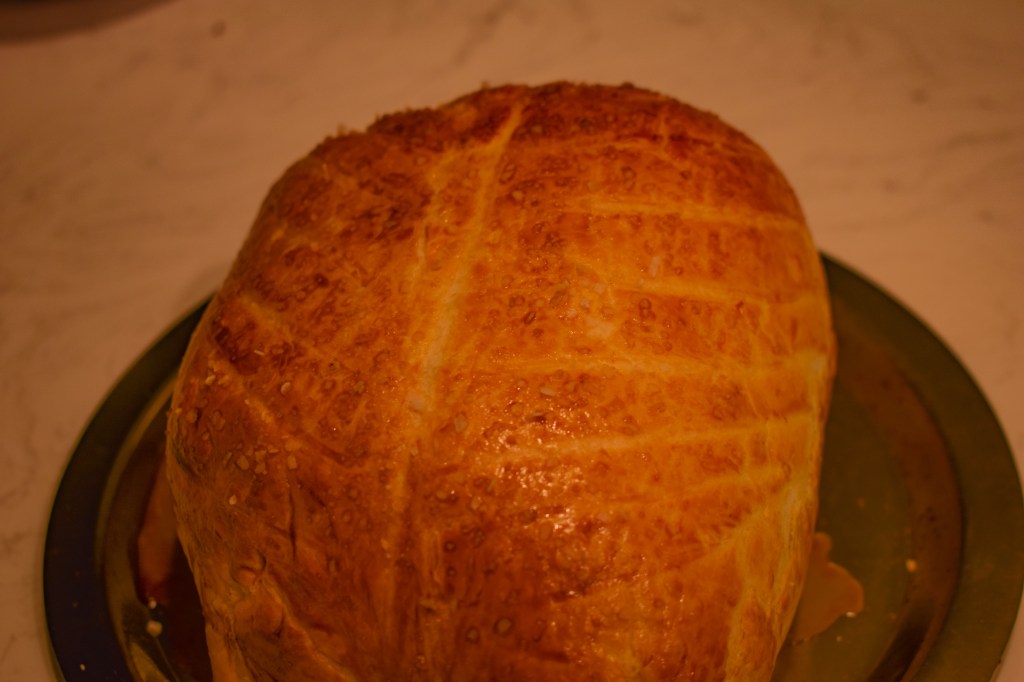
After it is done bakingYum!
Positives
For starters, I was very pleased with the color of the center of the wellington. It was spot on to the color I was trying to achieve. Very moist in the center and very tender.
The dish in all was seasoned very adequately.
The salt on the top of the puff pastry helped in making it very crispy in its texture.
Negatives
There was a bit of silver skin still left on the meat. This is very chewy to eat and should not be swallowed. Try to trim out all of the silver skin if possible, or ask the butcher to do it while buying it.
The mushroom duxelle was not covered all around the meat. Make sure that you spread the mushroom enough to cover the tenderloin completely.
The shape of the meat was not uniform. Because of this the meat on the inside was not cooked evenly. To avoid this, truss the meat before you sear it. But make sure that you do not forget the strings before wrapping and rolling it. You will find this video a little helpful in understanding how to truss a beef wellington: https://www.youtube.com/watch?v=rFIwbUBiRSE
This dish did not turn out to be the most perfect beef wellington. But most of the components turned out right and it was definitely very delicious, so I would conclude this attempt as a success.
References
Bali, P.S. (2014) Food production operations , 2nd
edn., India: Oxford university press
1 tsp of oregano (or any other herbs that you enjoy)
a few peppercorns
1 cup vinegar
1 cup water
1 tbsp salt
1 tbsp sugar
Method
The first step is to sterilize the mason jars. This can be done by placing them in boiling water for about 15 minutes. It is essential to do this for all preserves.
Wash the carrots well. Remove any dirt on them.
In the mason jar, drop garlic cloves, oregano, peppercorns and the carrots.
In a pot, add vinegar, water, salt and sugar and dissolve well.
Keep this mixture on high heat until it comes to a boil.
Once it comes to a boil, drop this mixture in the mason jar which contains the carrots.
For maximum flavor, refrigerate this for 48 hours before consumption.
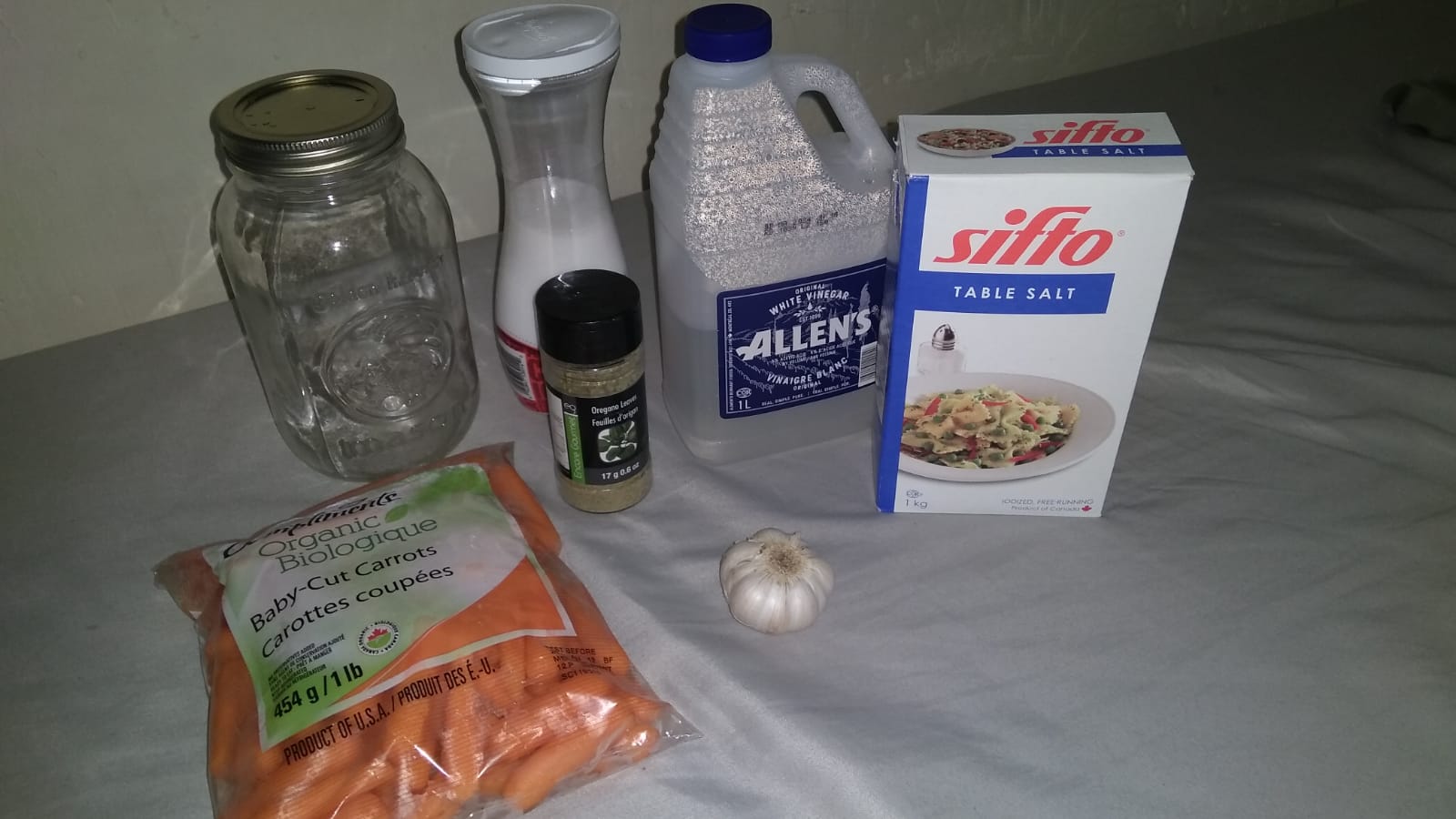
My ingredient
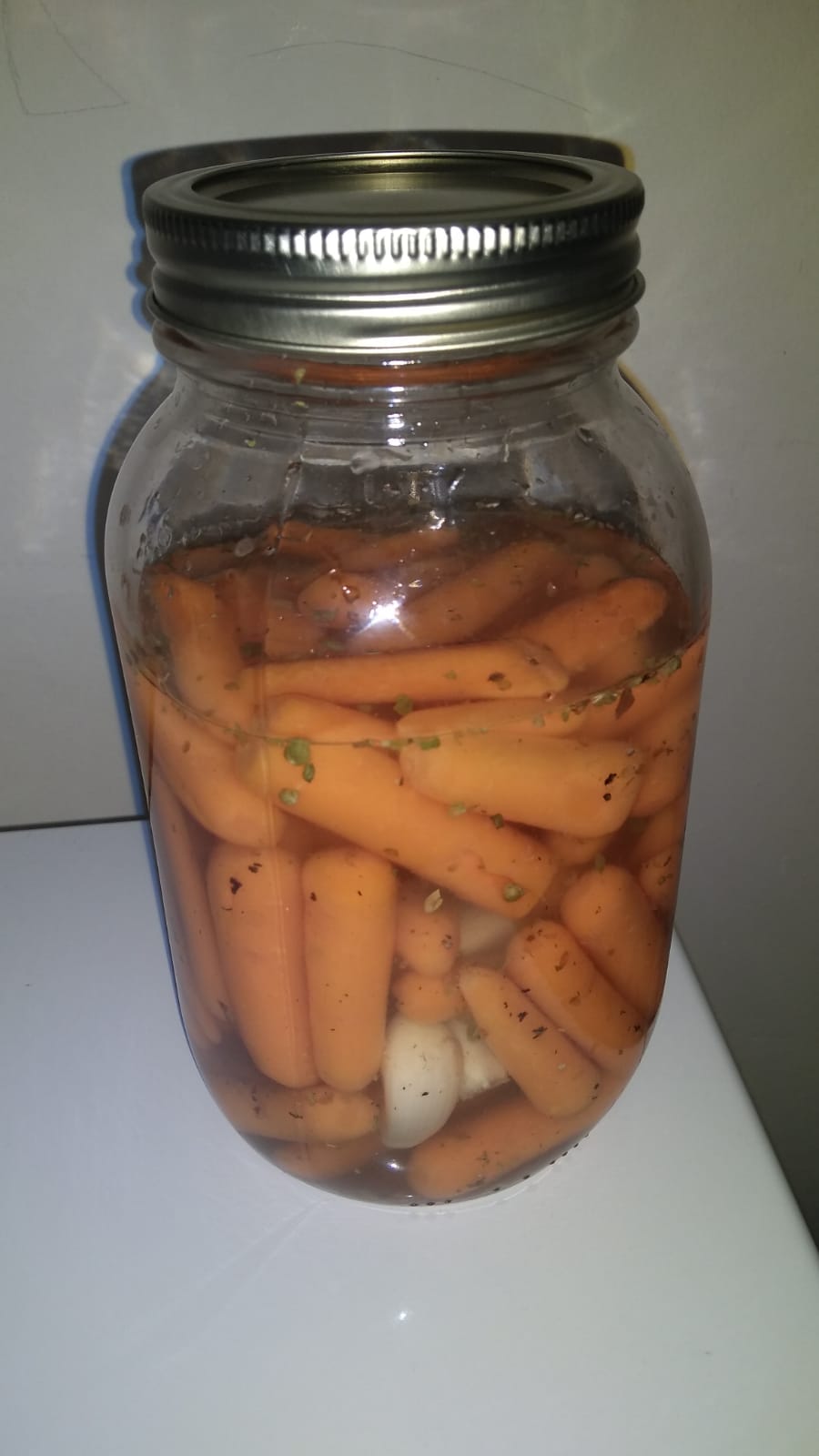
This method of pickling that I recently discovered is very different from the methods that have been practiced in my country. I wanted to give it a try by making a simple pickle of carrots. This will eventually help me understand the flavors in it and I can try this method with other ingredients. I chose baby-cut carrots because of their perfect size for pickling and so that I would not have to peel or cut them.
My method
The method that I used for this recipe is known as quick pickle. This is also known as refrigerated pickle. The flavor is not as deep as fermented pickles, but they require only few days before being eaten. They do not need canning while refrigerating. I found this recipe on thekitchn.com ( http://www.thekitchn.com/how-to-quick-pickle-any-vegetable-233882 )
Sensory evaluation
1 How does it appeal to the five basic tastes?
Definitely the first flavor that hits you is the sourness carried with the vinegar. But after a few moments I could also identify a little sweetness given out by the carrot. The oregano and the black pepper are noticeable as they add more depth to the flavor.
2 Using senses of taste, smell and texture, what do you observe?
As discussed before, sourness was the flavor heavily dominating the product. The carrots however, even being in the liquid for a while, still had a bit of a crisp to their texture. Every bite is enjoyable to have.
3 Are there similar flavors that you detect?
The taste of the vinegar reminds me of a dish back home made out of pig offals called sorpotel. It is a savory dish heavily dominated with the taste of vinegar. Other than that this entire mixture was a new experience for me.
4 How is the food unique?
For me, it is unique in the sense that I tried it for the first time. The use of herbs to flavor something that will be eaten cold was very unique for me.
5 What I would do differently?
The next time I want to try this technique, I would want to experiment with more spices and sauces (eg. soya sauce).
Thank you for reading my blog. This was the first time in my life that I have ever tried to pickle something, and I had fun doing that and learnt many things along the way.
In this blog I will discuss about a food that I have tried for the first time.
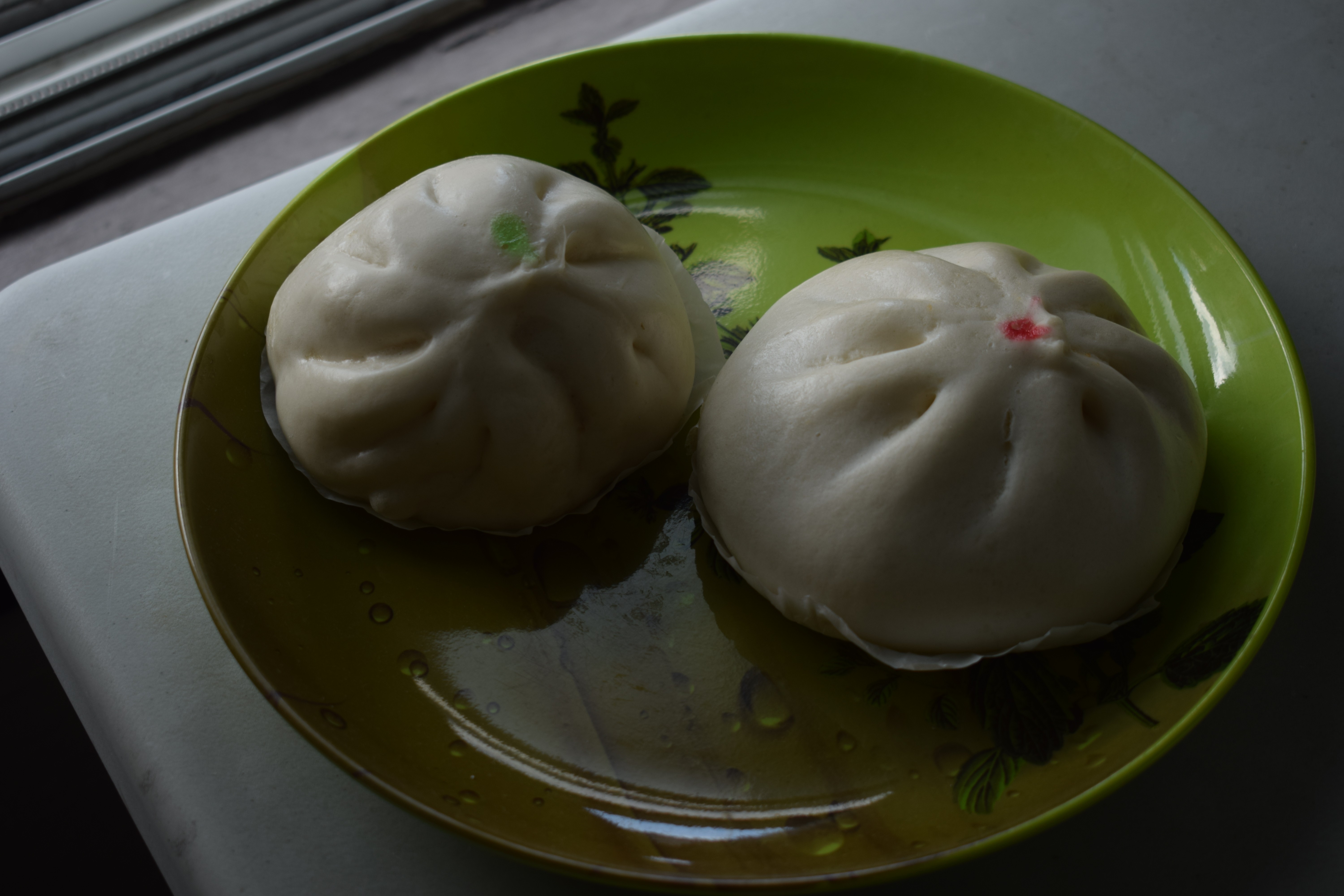
Steamed Buns: It is something that has always intrigued me, but never got a chance to taste it. The first time I came to know about this delicacy is when I watched it in a movie called “shaolin soccer”. The dish is of a Chinese origin. It almost looks like a bread roll, but completely white in its exterior. They have a variety of fillings but the most common one is the red bean filling. I found a place called ‘new bakery’ on Gerard street west where they serve different types of buns.
Taste test
Initially I had thought that steamed buns are very similar to dumplings. Dumplings have a very thin layer of covering outside its filling. I found steamed buns to have a thicker covering than dumplings and a very different flavor profile. The flour covering used for the buns are sweet. I actually picked two buns which were spicy chicken and roasted pork. This filling completely changes the flavor of the dish. The filling is very rich in the flavor of umami along with some sweetness carried in it. The texture of the bun is very chewy to the bite, which shows existence of gluten in it. The texture of the filling is very soft to the bite and contains a lot of moisture. This combination allows for the easy swallowing of the bun which might seem like a tiring process to bite.
The texture and taste of the bun is very similar to an Indian dish called ‘Idli”. It is a traditional south indian dish mainly eaten during breakfast. I remember my mother making this for occasions to eat along with some chicken curry. This combination of sweet and savory reminded me of the dish back home.
Verdict
The experience of eating this dish was very pleasant and (sort of) a trip down memory lane for me. I was only able to try out two of the fillings available, but I surely am going to try all the different flavors that there is to serve because I want to understand which flavors work and which do not. In this process I am looking to also develop my own palate. One thing I would change about the dish, is that the filling should have been a little more spicy. I am going to try and cook up a version of my own steamed buns no matter how tedious the process might seem like.
This is one of the soups that is a brief walk in my memory lane. I was about sixteen years old wand I wanted to try out something different. During that time, I had tasted a classic Thai curry with rice, and I developed an instant liking towards the flavor of Thai basil. I wanted to infuse this flavor in a clear broth, would not use any oil but at the same time be something that would also taste delicious. (as I learnt later on, this soup works magic for a person with cold or a stuffed nose). For this recipe I wanted to tweak something and find out how the outcome would be with Italian (fresh) basil leaves. Also, I usually prepare it with either chicken stock or a variety of shellfish. For this recipe, I used plain water to test how the vegetarian version would taste like.
RECIPE
Ingredients
Ginger – 1 inch
Garlic – 2 cloves
Thai chilly/ bird’s eye chilly – 1 pc
Onion – 1 (small to medium sized)
Carrot – 1 (small sized)
Mushroom – 40 gm
Fresh Basil leaves – a handful
Salt – to taste
Black pepper – as per required
Procedure
First step is to prepare all your ingredients except the basil, salt and pepper.
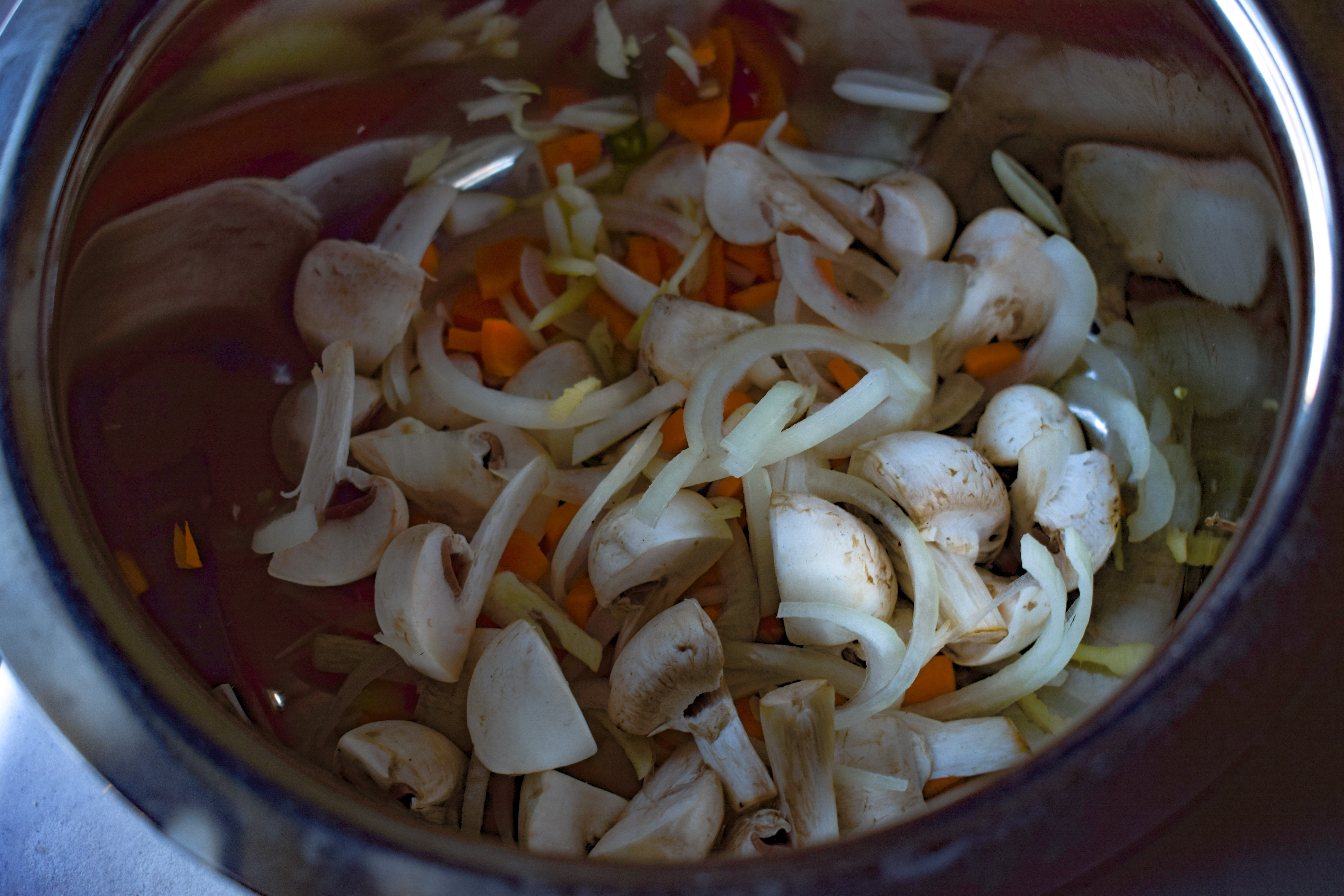
Thinly slice onion and chilly, make julienne of ginger and garlic, make paysanne of the carrot and quarter the mushrooms.
Transfer these ingredients in a stock pot and cover at least 2 inches above it with COLD water.
Let it cook on medium to low heat, skimming all the while for impurities. Let it slowly come to a boil.
As soon as it starts boiling, it is time to season with salt and pepper. Use the black pepper sparingly depending on how much spice you can handle.
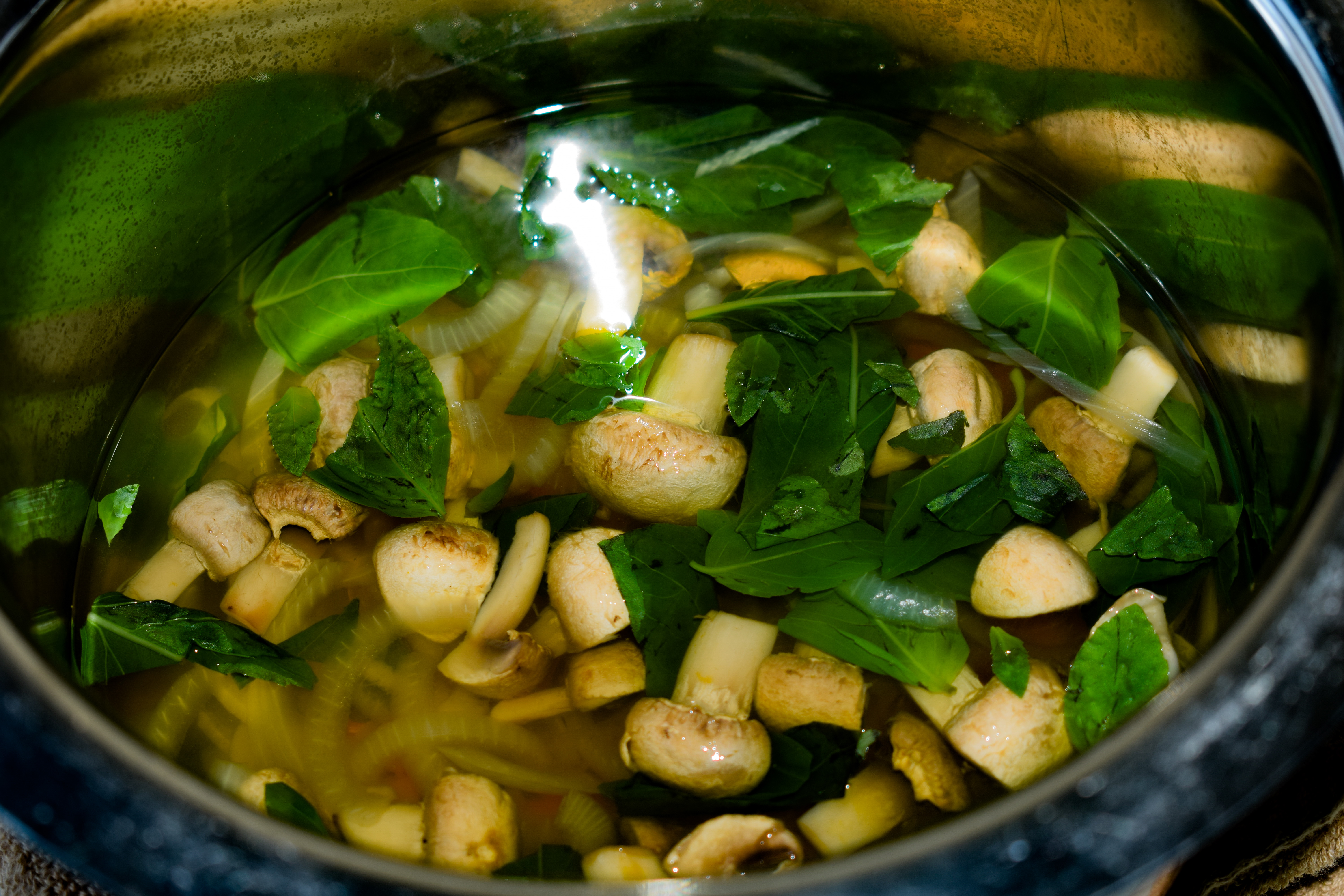
Tear the basil with your hands, do not make it too small. Keep processing of basil to the last minute to not loose any extra flavor.
If the seasoning is perfect, add the basil leaves and boil the entire mixture for 2-5 minutes. (If making the seafood version, add prawns, squid or any of your favorite shellfish along with the basil. Do not boil any further or else it will result in discoloration.
Cover the pot and let the flavor of the basil be infused in the soup.
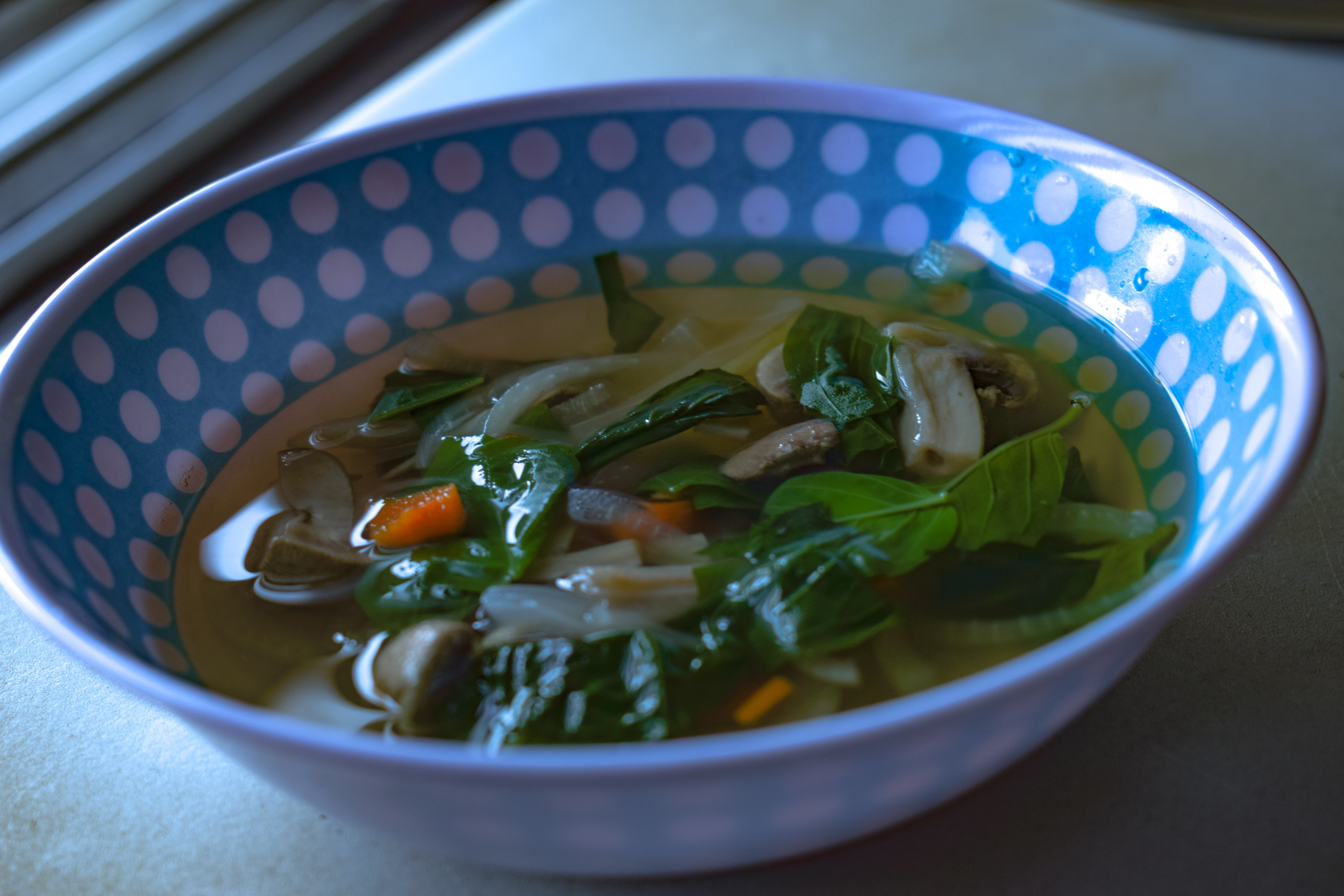
Serve it hot!
VERDICT
To be very honest, this variation of a soup that I have been making for a very long time, was not as good as the usual recipe (with Thai basil). The flavor profile was present, with a bit of umami spread because of the combination of ingredients and the flavor of mushroom. There was also a bit of bitterness spread because of the basil which usually is not there with the Thai basil leaves. The bitterness is not off putting and a little soothing in a way. This gives me an idea of combining both the Italian and Thai basil for this soup.
I was lucky enough for my aunt and her children to visit me on a weekend. She enjoyed it a lot, but her kids did not like it at all. Only complaint was that it was ‘too bitter’.
The main challenge faced by me was, to adapt to a new kitchen that I had never worked in. It is congested and the (sensitive) fire alarm keeps going on. Even though the soup was not to par, I would say it has been a lesson on what to do and what not to do in my next attempt. So I would say it was a success.
Being away from home is the biggest challenge, and I have started picking up on that. Cooking is important not only as a profession, but it should be learnt as a necessary skill. It is healthy to do so as well as cheaper. I can definitely use the knowledge accumulated for my future endeavors.
Before going into detail about vegan diet vs animal diet, we must understand what a plant based diet truly means. From the name itself, we come to know that it is a diet that revolves around natural ingredients and there are no animal products involved in them. In proper words, plant based diet focuses on food that is minimally processed, avoids products produced from animals and gives more attention to diet including of plants such as vegetables, fruits, whole grains, etc (Kubala 2018). Unlike a decade ago, there is an evident increase in number of people that are opting for more plant based foods while going outside to eat (Davis 2019).
Benefits
Adopting a plant based or a vegan diet comes along with a few perks:
There is a reduced risk of developing heart conditions later on in life. A study conducted in Netherlands and Brazil found that most people following a plant based diet were less likely to suffer from heart diseases than people following animal based diets (Newman 2018).
Following a plant based diet can heavily reduce the risk of chronic diseases such as type-2 diabetes and certain cancers can also be avoided (Imatome-Yun 2019).
Plant based diets can also be a very effective way to loose weight much faster than by following a meat based diet. Many researches out there prove that vegetarians are prone to consume more foods of less calories and thus, not gain excessive weight (McMullen 2016).
If it were possible that more people stop eating meat in their diet, there can be a drastic change in environment. Production and consumption of meat has proven to increase the carbon footprint over the years and therefore, reduction of it will start putting things in balance (Fortuna 2019)
For the time that I have existed on this planet, I have been a non-vegetarian, and like most of my peers, I simply cannot comprehend that I might take up a vegetarian. Although, I have recently increased the ratio of my vegetable intake than my meat intake. Even though my taste buds aren’t happy with this fact, my body surely is, and I have definitely seen changes such as increased activity levels.
On a professional level, I haven’t really given it a thought if I will ever incorporate more vegetables than meat. But surely it is an area of interest for me as i lack a lot of knowledge and skills to cook something that is both good and does not include any animal products.
Recipe- Mushroom and Basil Soup
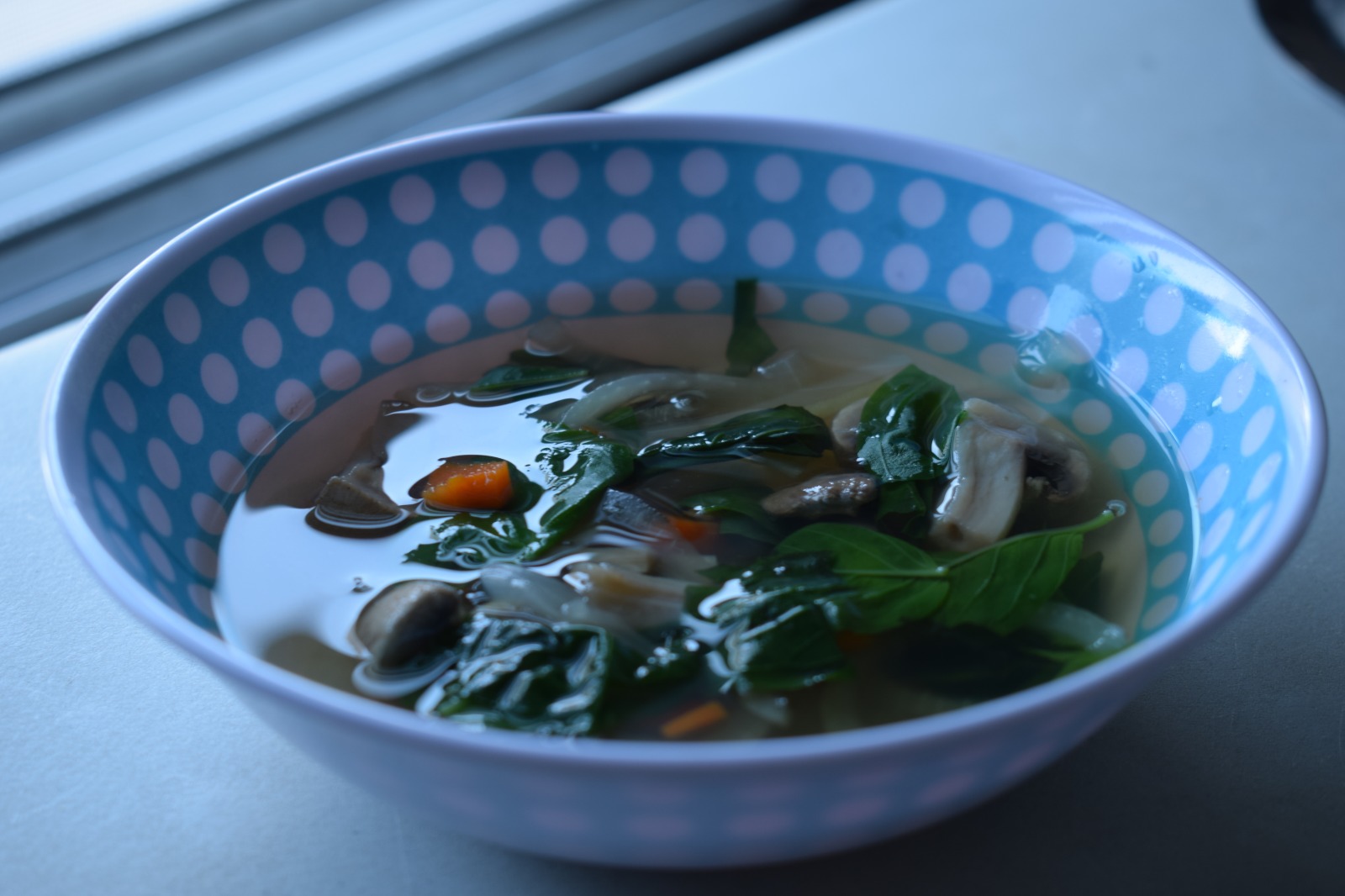
One of the most simplest things that i have ever learnt to make. Almost like a broth, it is a thin soup, but also has a bite to it. It is tasty, it is vegan and also, it is heaven on a cold day.
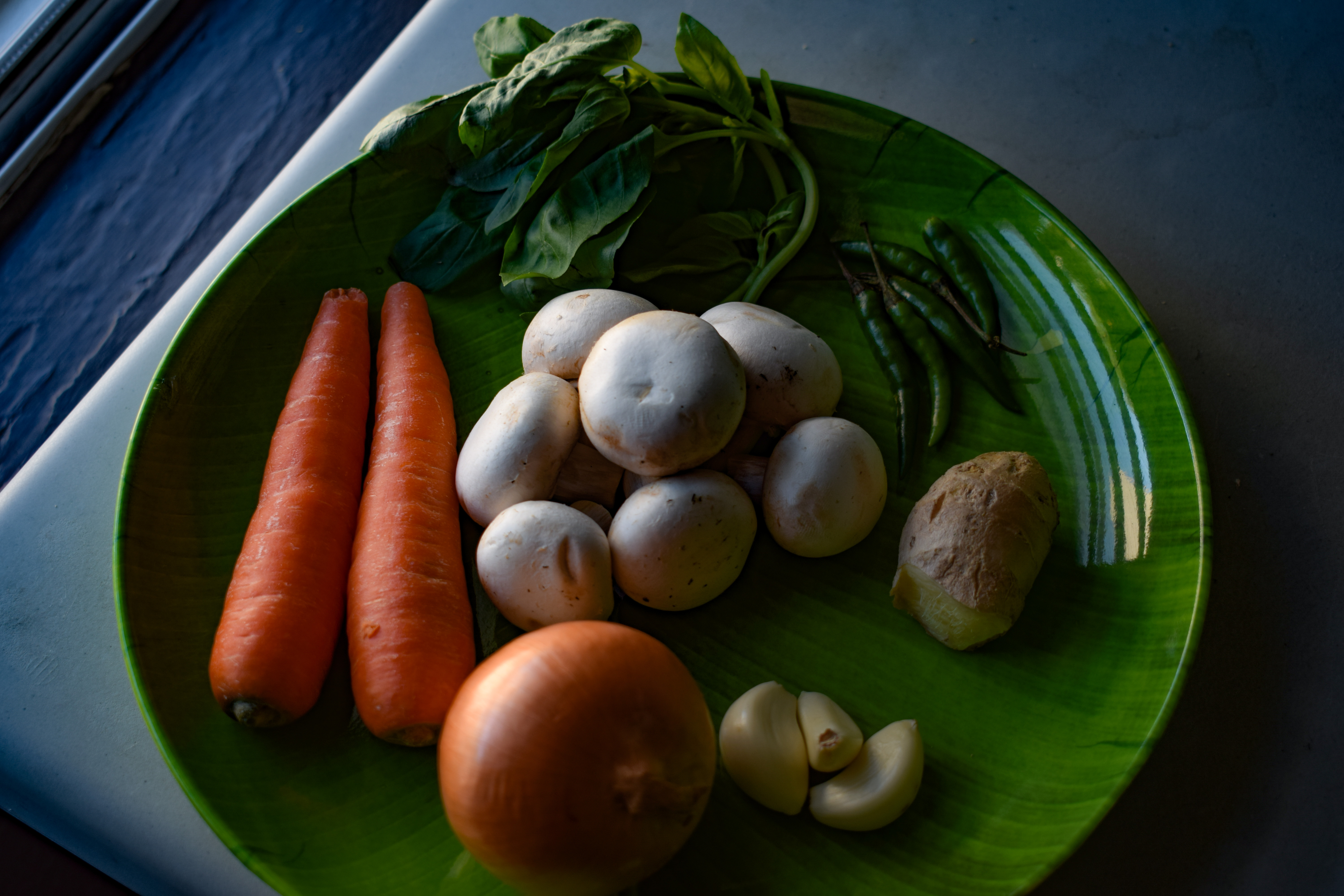
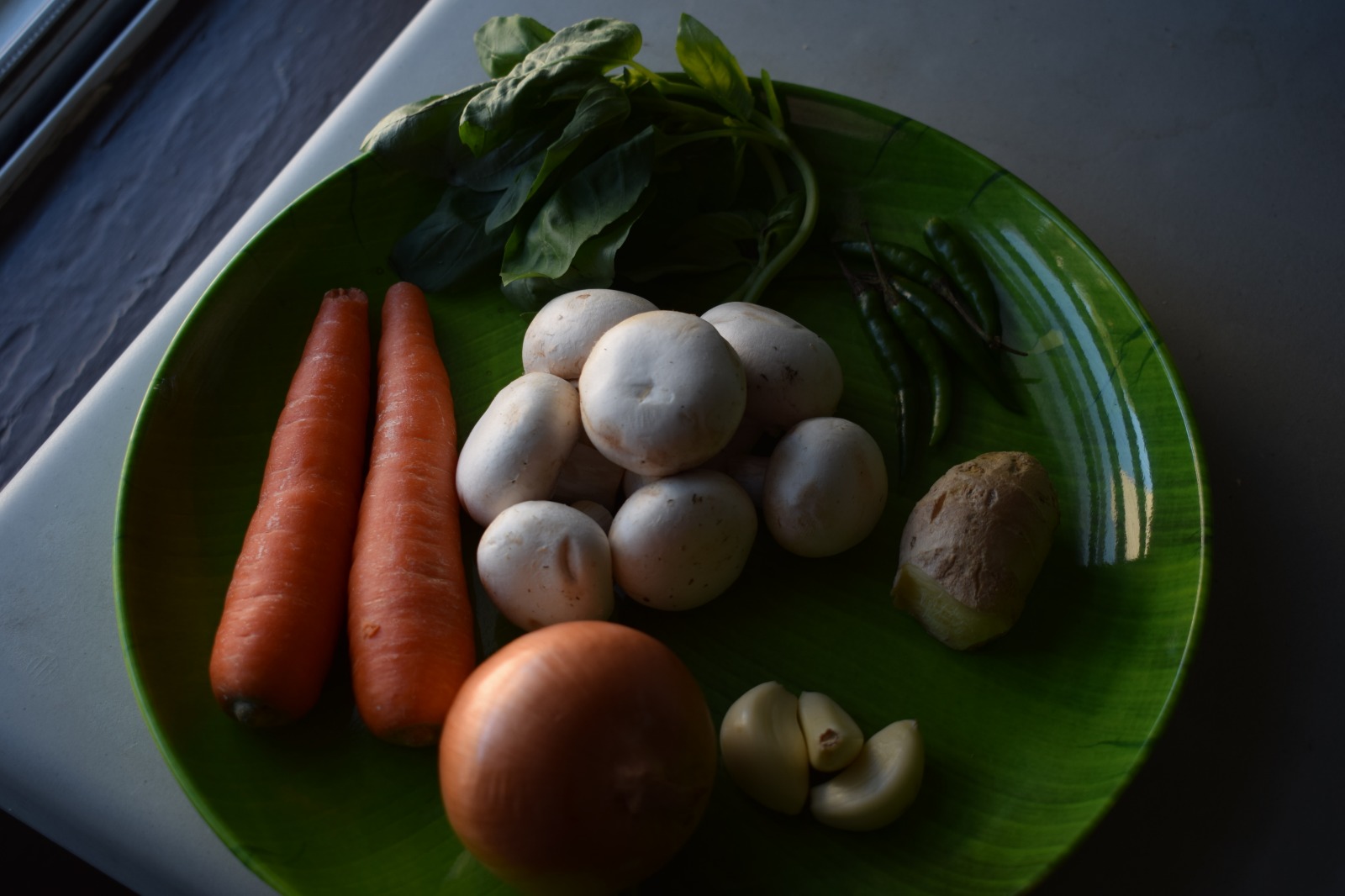
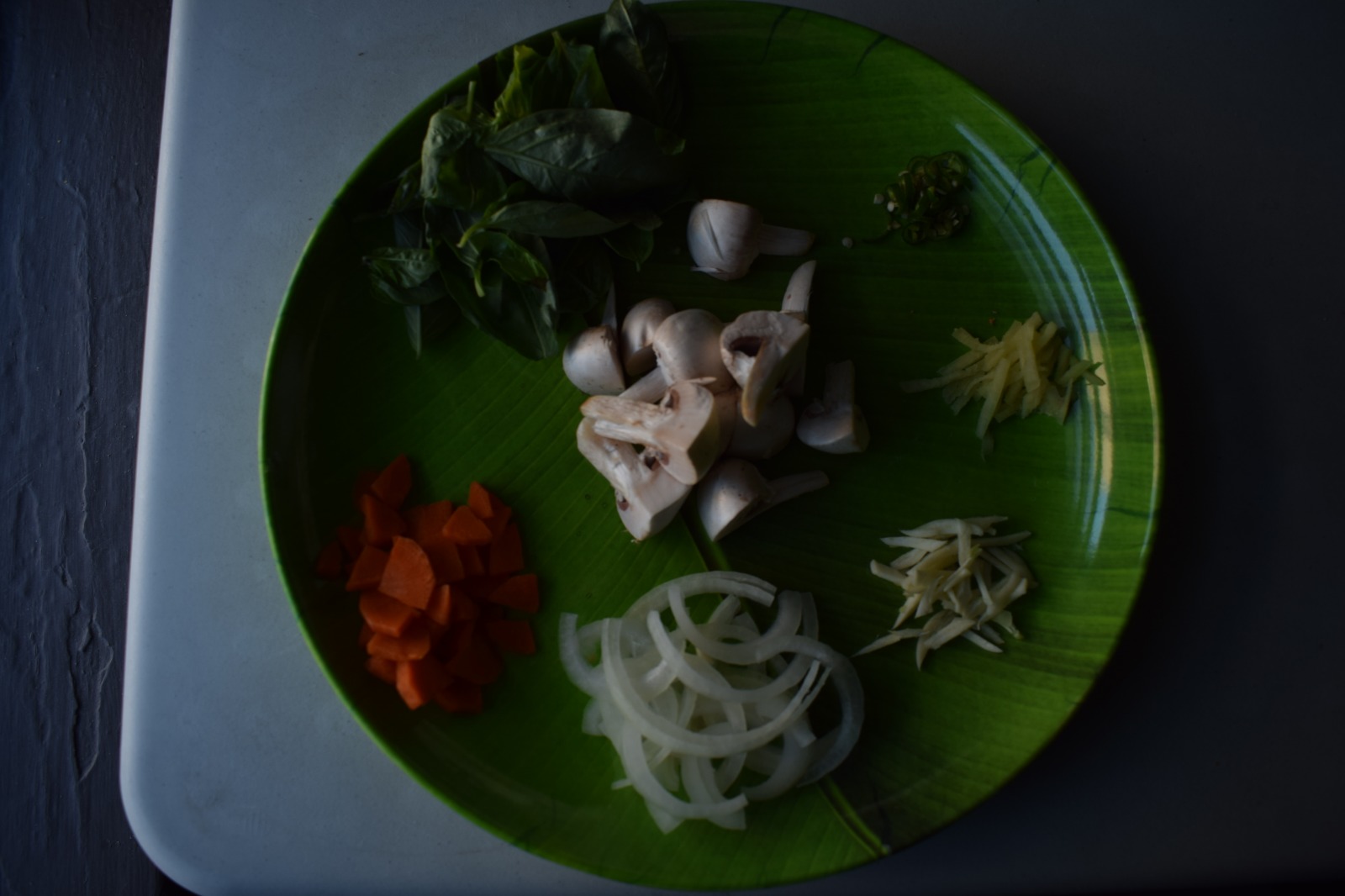
YOU WILL NEED:
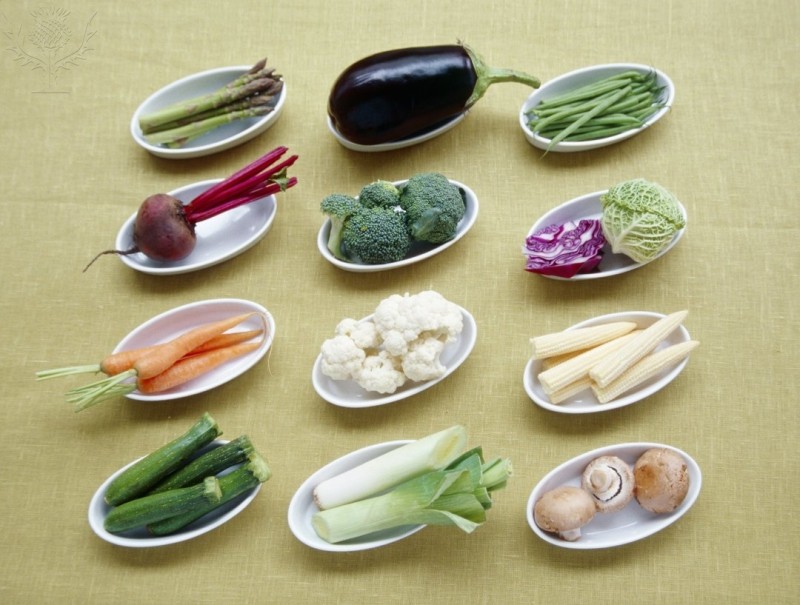
Picture not to scale. Only for reference.
Ginger – about 1 inch
Garlic – one clove
Thai Chilly/ Birds eye Chilly – one
Onion – half of a medium size
Carrot – one of a medium size
Mushroom – a handful (6-7)
Basil – a couple of sprigs
Salt – to taste
Pepper – as per required
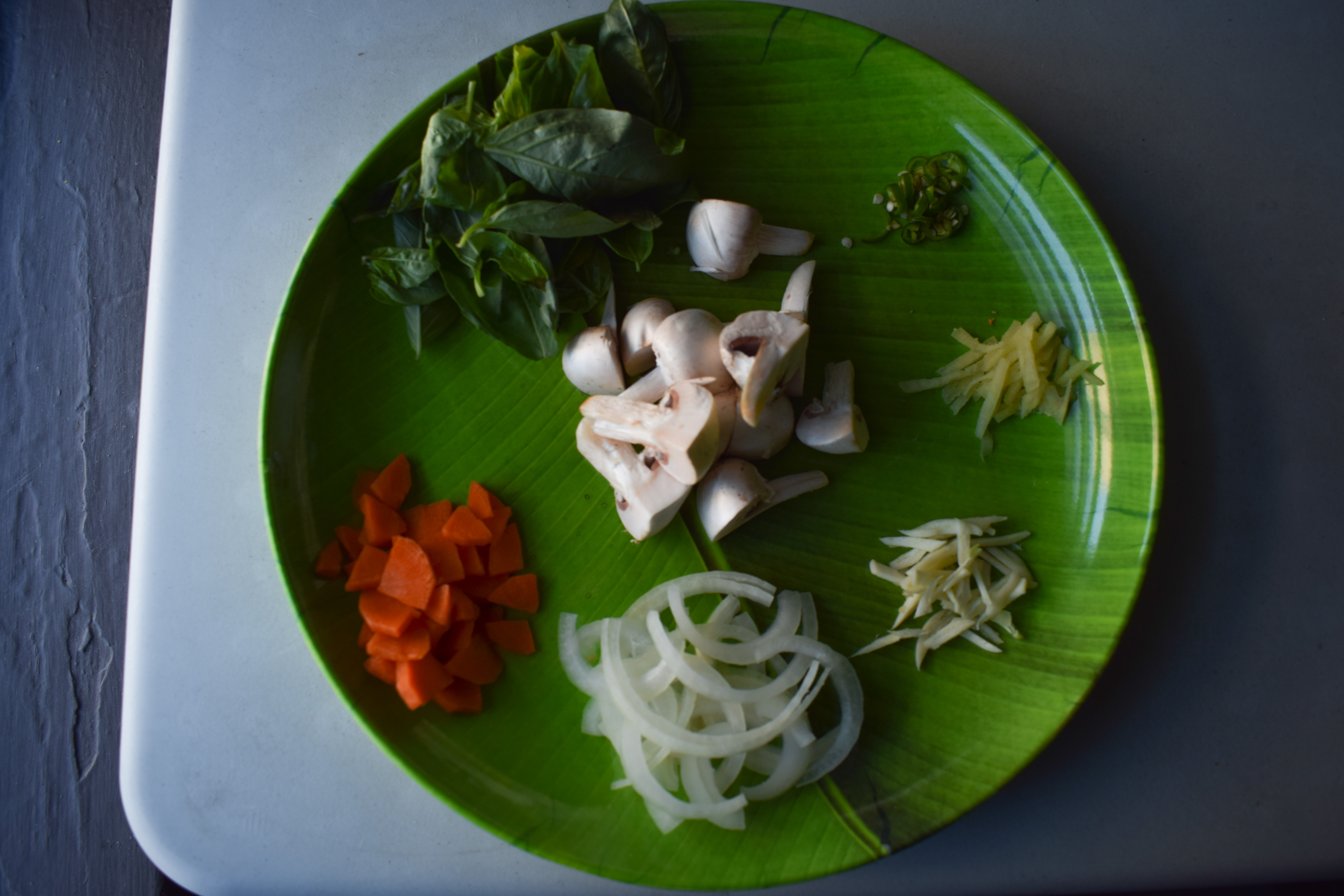
PROCESS:
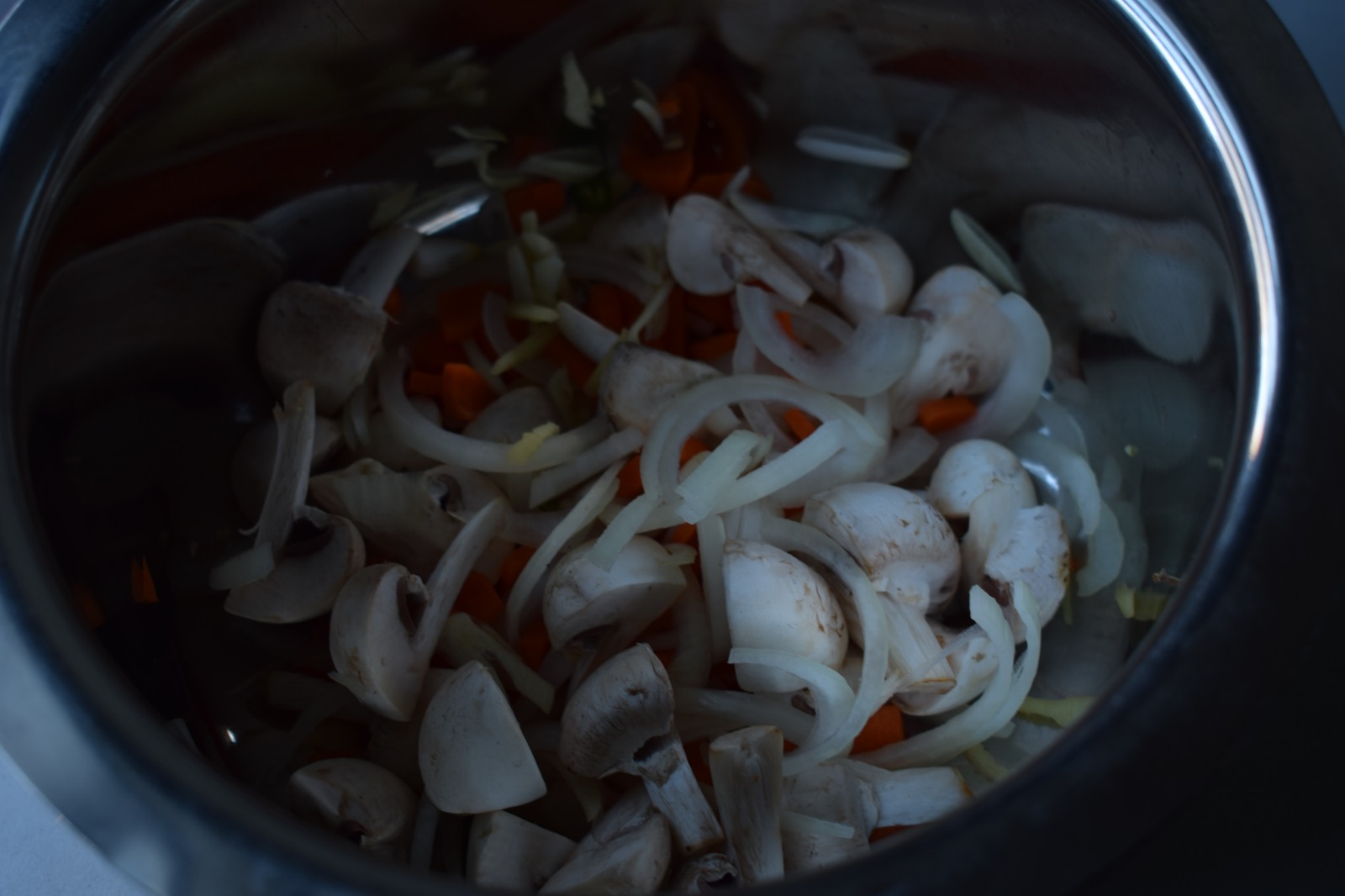
Picture not to scale. Only for reference.
Thinly slice ginger, garlic, chilly and onion. Cut the carrots into medium sized pieces (does not need to be accurate). Cut the mushrooms into quarters.
Set aside basil towards the end of cooking.
Shift all the ingredients (Except basil, salt and pepper) into a pot and fill it with cold water. The water should be 1 inch above the vegetables.
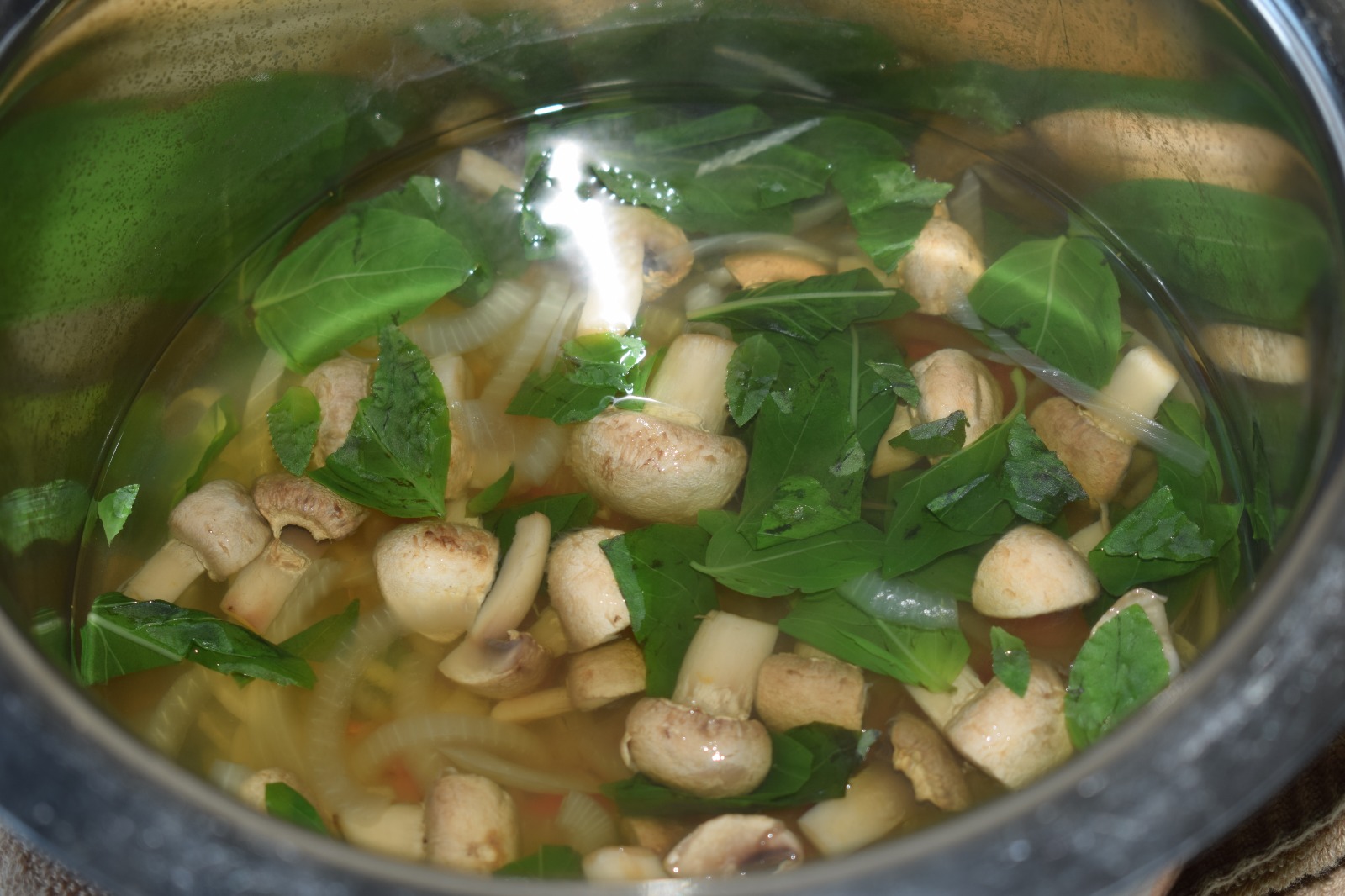
Keep this pot on a slow heat and let it come to a simmer gradually. At this point, tear up the basil with hands and add it to the pot.
Boil the soup for 2 minutes and add seasoning as per requirement.
Do not boil any further as basil will lose its color and it will start going brown.
OUTCOME
The recipe is pretty straight forward, with all ingredients available at nearby stores. Although, this recipe was meant to be prepared with Thai basil and not normal Basil. This proved to be a challenge for me as it was very difficult to find it near my area of living and hence, I went ahead with the normal basil leaves. There is a completely different flavor profiles to either of the basil leaves and so, the soup was not as good as it would’ve been with some fresh Thai basil. As I am far away from home, I definitely have picked up a few skills in my culinary profile such as managing in a small working environment. Would I ever make the dish again? A sure yes, but with a little tweaks here and there.
Nutrition is one of those topics that spread out into many different branches. Spreading out into different fields of science as well as research. I have only discovered this field of study in more detail only after joining George Brown College for my culinary management program. Throughout all my years of studies, I have never given so much importance towards understanding nutrition as I do now.
Interests
One field in nutrition that has intrigued me particularly is the topic of digestion of food in the human body. I had never imagined that the science behind absorption of nutrients from the food to the body would be so intricate. Another field that I want to learn more about is organic and sustainable farming. The world is getting bigger, and demand is increasing. To live on this earth together, everyone must understand the meaning of sustainability. Organic may not always be sustainable, but we need to find a way to do it, as there are so many antibiotics used in large scale farming.
The world is increasingly getting aware about health and food intake. Unlike before, people are taking way more interest in understanding what they are eating. And there has been a rise in the number of people who opt for healthy and nutritious food. Professionals in the hospitality industry have to keep this in mind as it is going to heavily influence the industry going forward
Health and Nutrition websites
There are a few nutrition websites online where a person might details about this topic in very much detail. I have handpicked a credible website and another which cannot be deemed entirely credible:
On this website, information on various topics can be found which all mainly revolve around health and safety of the consumers buying any products. As soon as you enter the website you come to understand that it is a government, a good indicator that the nutrition website is credible and that there is a lot of research done to find the information.
The website looks very promising with many details about nutrition and diet. But reports from various sources, show that the website lacks in research and sticks to ideological beliefs more rather than concrete evidence.
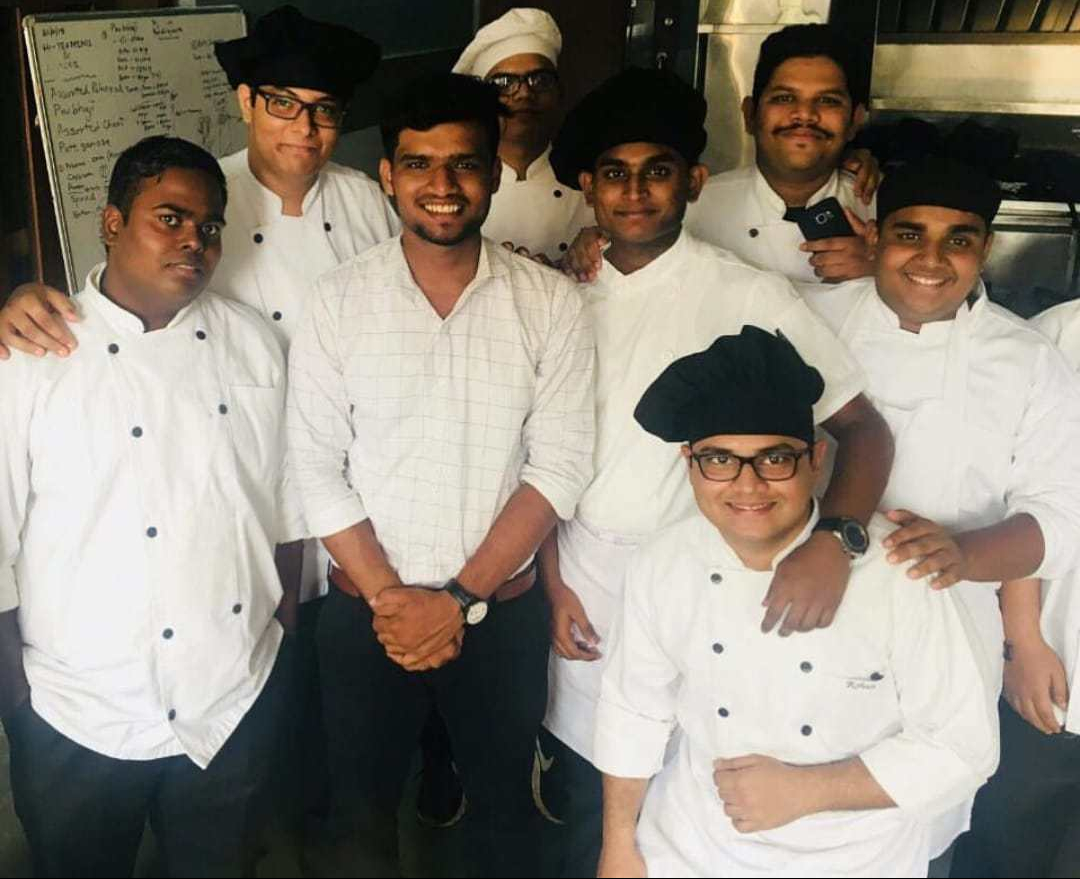
(Me in the bottom right) Iv’e selected this particular picture to signify the importance of teamwork in a kitchen
Thanks for joining me and welcome to my ‘cook’s biography’!
This is a blog covering certain details about me pertaining to the subject of cooking and my personal beliefs and ideologies about it.
Why I want to be a chef?
In this world, people are trying to achieve something in order to gain monetary rewards or a sense of completion of a goal fueled by passion. It is not fair to say that I belong to the group of people in the former, but my major motivation to become a chef is because I am passionate about cooking.
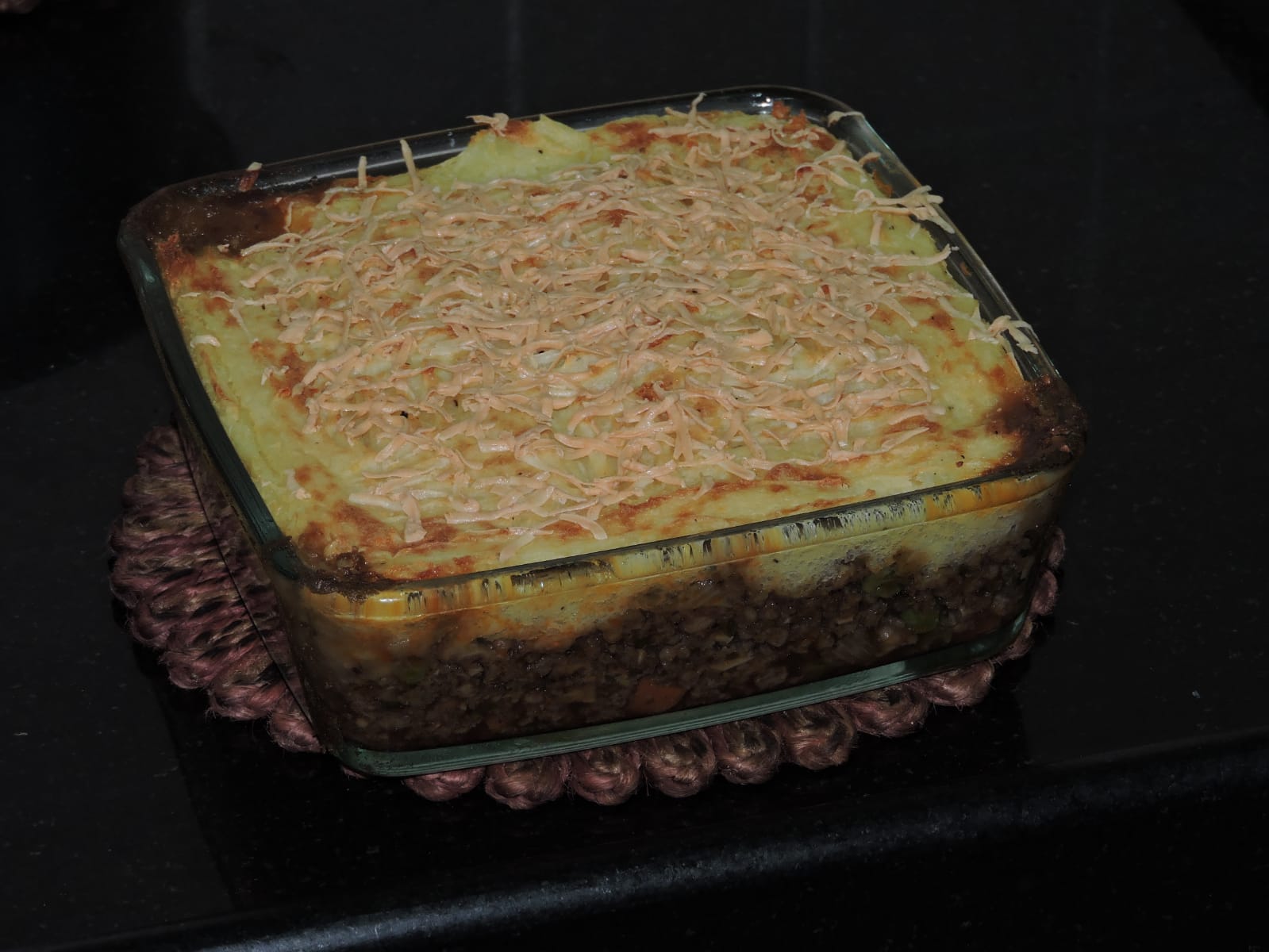
This was my first attempt at a traditional ‘shepherd’s pie’
I discovered this passion ever since I was in preschool back in India, not because I was good at it, but because I was simply so bad at it. One thing to know about me is that if there is a task that I am interested in but do not understand how to perform it, I like to perfect myself into it. Eventually through trial and error, I became capable of putting up a meal on the table for my family of four.
Most of my lessons come from the first chef that I trained under. ‘My Mother’. Through her, I have learnt some combinations of different spices for different dishes, although most of her recipes contain such combination of these spices, that it will take me years to truly understand.
My work in the Industry
I do not have much exposure to the industry. I was doing my bachelors degree in International Hospitality and Tourism back in Mumbai, India. During this program, I had to do a 20 week internship, and i got myself placed in The St. Regis, Mumbai. These 20 weeks were divided for training in the core four departments in a hotel. Therefore, I got about a month’s experience in the banquet kitchen, which during that season was the most operating kitchen in the entire hotel. I got exposure to cooking taking place in huge quantities mostly happening for wedding events. On few occasions I would sneak myself into the butchery and the garde manger only to see how those sections of the kitchen operate.
Currently, as I am pursuing my
culinary management diploma from George Brown College, I have even found myself
a part time job at Porchetta & Co. which is located on King street west. At
work, I am learning different types of mise en place such as different sauces,
meat butchery, preparing work station along with working on the line which
includes preparing sandwiches and side dishes.
My definition about cooking is
something related to homely rather than acceptable by most individuals working
in the industry. I believe that cooking is a passion driven by a want to feed
and strengthen a person or persons. It is the art of understanding different
ingredients and the combination of these ingredients to make a dish to serve
loved ones.
“My first outdoor cooking memories are full of erratic British summers, Dad swearing at a barbecue that he couldn’t put together, and eventually eating charred sausages, feeling brilliant”
Jamie Oliver
I also am a firm believer of cooking
with fresh ingredients. I like to work with the least amount of ingredients for
a dish with a lot of flavor in it. Cooking with seasonal ingredients does not
need overworking with different enhancers as a fresh ingredient by itself
contains a lot of packed flavor inside it along with its nutritional
aspects.
“Mother nature is the true artist and as our jobs as cooks is to allow her to shine”
Marco Pierre White
What do I gain from blogging
I do not have much experience in the field of writing or blogging. Therefore, what I wish to learn from this is the experience of expressing something in literature. Along with this, writing about experiences can be a form of self reflection. This will in turn help me understand strengths and weaknesses where i would have to improve. This self reflection will eventually help me to improve not only as a person but also as a chef and further be beneficial for me in my future career.
Reference
As a person wanting to learn and grow in the food industry, I have found a blog that will prove beneficial for not only me but many of my peers. The blogs written on the Chefs Resources website ( http://www.chefs-resources.com/blog/ ) cover a wide range of aspects about the industry from kitchen staff management skills to the changing market in the restaurant industry. It even covers topics for chefs who want to choose a different career path. Only thing that would make the blog better is if it were a little bit more neat and organized. Other than that, it is a very informative and up to date website for anyone who wants to boost their career.




 Theory Of Food